

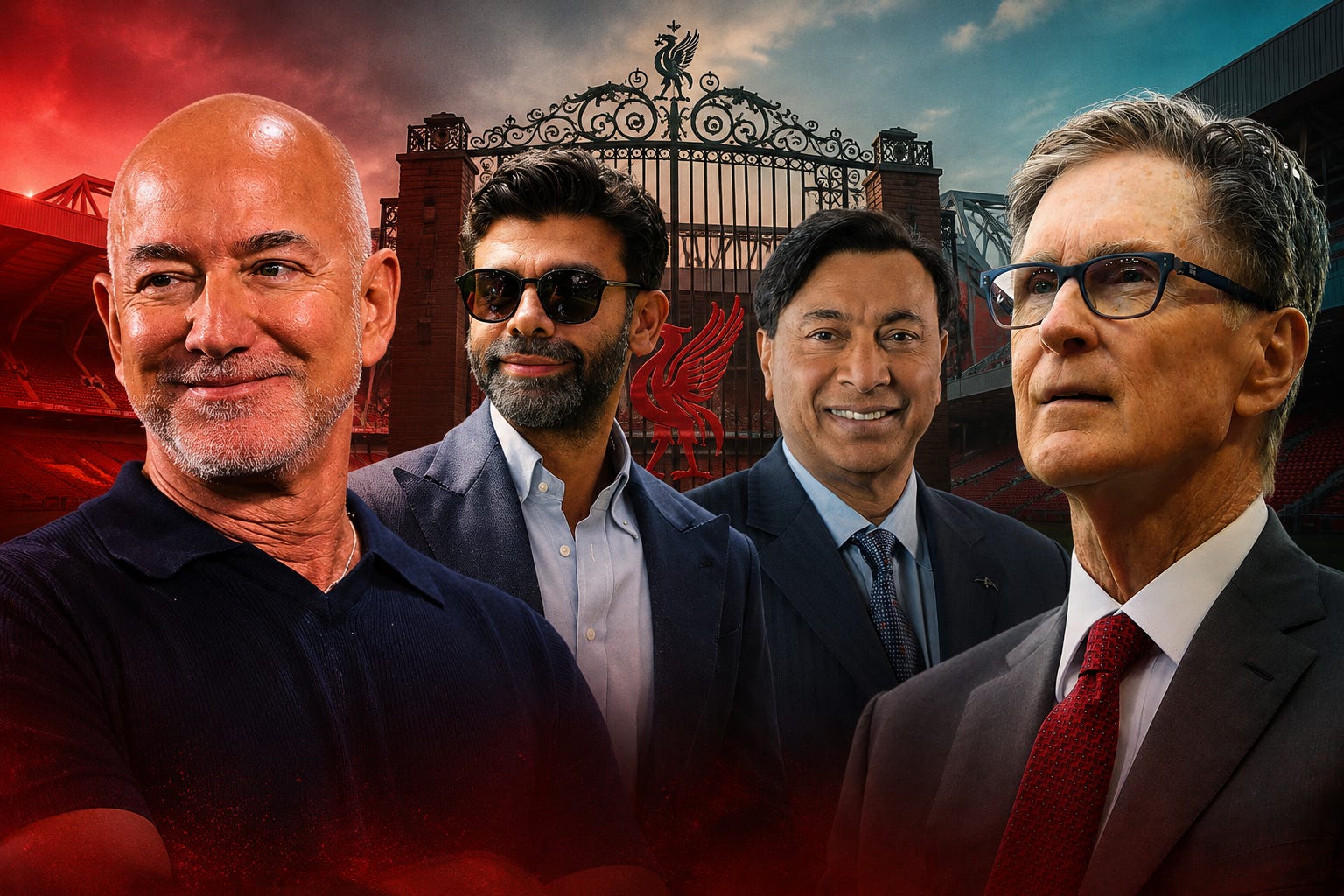
Liverpool FC won’t be sold today. That’s the first fact worth holding onto.
Fenway Sports Group remain in control. Talks over a minority investment are still at an early stage. Jeff Bezos has reportedly been approached about joining a consortium led by Amit Bhatia. No agreement has been signed, no transfer budget has suddenly multiplied and no billionaire has arrived at Anfield carrying limitless wealth.
Yet something has changed.
Sometimes football stories are significant because of what has happened. Others matter because of what they suggest. This feels firmly in the second category.
The proposed investment, the reported valuation and, above all, the calibre of names being linked to Liverpool all point towards something bigger than another routine corporate transaction. Whether this process concludes in six months or six years almost becomes secondary. It feels like the club is entering the final chapter of Fenway Sports Group’s ownership, even if the final page has not yet been written.
That is not criticism.
It is simply recognising how investment works.
FSG purchased Liverpool for around £300 million in 2010. They inherited an institution staring into the abyss after years of catastrophic ownership. Sixteen years later they preside over a football club valued somewhere between £4.5 billion and £6 billion, depending on whose figures you believe.
That represents one of the greatest returns in modern sport.
Investment groups do not create that level of value simply to admire it forever. Eventually, value has to be realised.
A minority investment achieves several objectives at once. It crystallises a market valuation. It introduces potential long term partners. It provides liquidity. It can also quietly establish a pathway towards future ownership without forcing either side into an immediate sale.
That is why I believe this deserves far more attention than simply asking whether Jeff Bezos might one day sit in the directors’ box.
This could be the beginning of the end for FSG.
FSG Have Reached Their Natural Ceiling
There is a temptation among parts of Liverpool’s support to frame every ownership discussion as either unwavering praise or relentless criticism.
Reality sits somewhere between those positions.
FSG have transformed Liverpool.
They appointed outstanding football executives. They empowered elite recruitment. They built a world class training complex, expanded Anfield and restored Liverpool to the summit of English and European football. They backed managerial appointments that delivered every major trophy available.
Their stewardship deserves enormous credit.
Yet football refuses to stand still.
The model that elevated Liverpool to the top has become increasingly difficult to sustain.
