


Liverpool have a to do list. Julian Ward knows it, Andoni Iraola will know it and anyone watching this side regularly can see where one of the priorities sits.
Midfield.
There are other significant issues hanging around, including the situations involving Alisson and Virgil van Dijk, but when I look at the midfield and what Liverpool currently need, I keep coming back to one player.
Lamine Camara.
We have looked at Camara before on Transfer Market Metrics. He was never a bad option. The issue was that when we previously assessed him, there were other players around him who perhaps offered more in particular areas.
Something has changed.
Watching Camara this season, particularly against Strasbourg, I saw development in his game that makes him considerably more interesting. He still provides the defensive qualities you would expect from a defensive midfielder, but his work in possession has moved forward significantly.
For me, that changes the entire conversation.
Camara’s Passing Development Changes Everything
The most striking development is his passing.
Camara has gone from being relatively safe in possession to trying more progressive passes and completing them. His passing accuracy has risen by almost five percentage points compared with last season, while his line breaking numbers have improved too.
Against Strasbourg, he completed around 92% of his passes. He also produced an assist and regularly progressed possession into the final third.
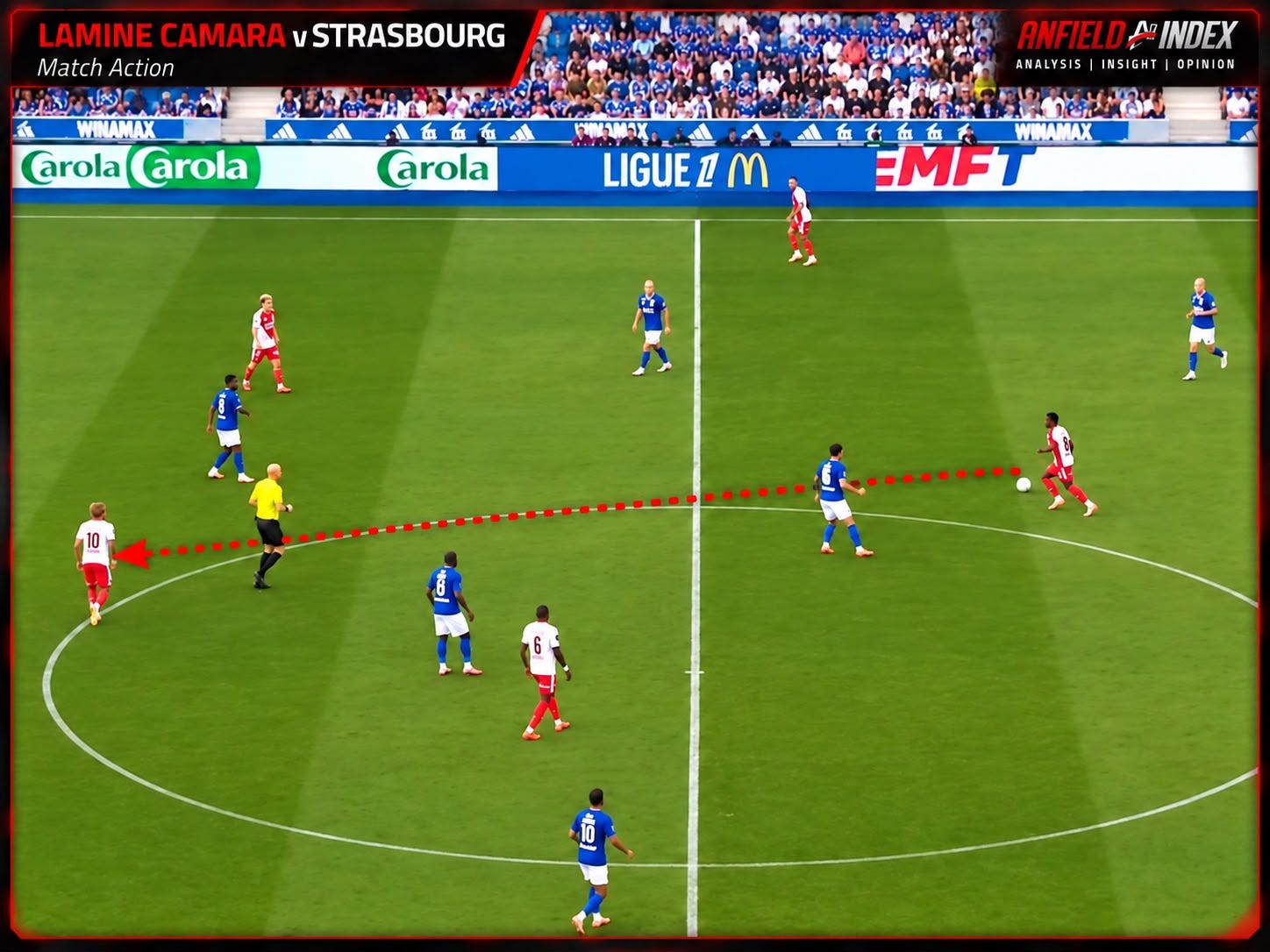
There was one technical detail that particularly stood out when we analysed the footage. Camara is receiving on his back foot much more consistently. That opens the pitch immediately. Instead of receiving possession and simply moving it to the nearest available player, he can receive across his body, look forward and punch the next pass into an attacking area.
That matters.
He played some excellent switches against Strasbourg and showed the ability to feed passes through midfield. Around 80% of his long passes were completed in that game.
This development has occurred without sacrificing what made him interesting originally.
He remains disciplined in front of the back four. He protects the defence, stops transitions and wins possession. The difference now is what happens after he gets the ball.
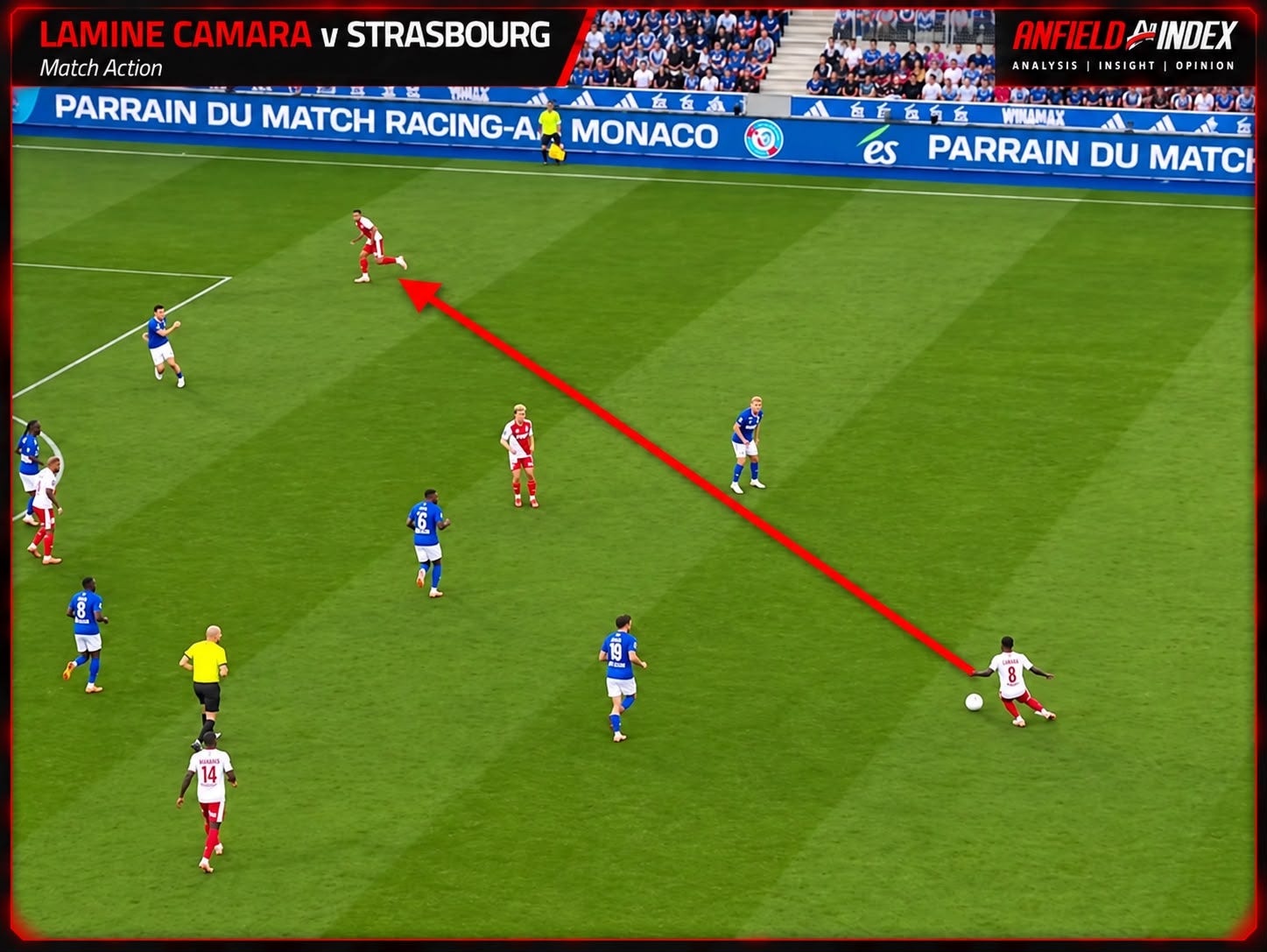
His defensive numbers remain extremely strong. In the Strasbourg game, he ranked around the 97th percentile for recoveries and 90th percentile for tackles. His ground duel numbers were also strong.
We could not obtain physical data from Ligue 1, so I cannot tell you precisely how much distance he covered or how much high speed running he produced. I can only judge what was visible from watching the game, and he certainly did the running required of him.
That combination is what interests me.
Numbers Show a Midfielder Moving Rapidly Forward
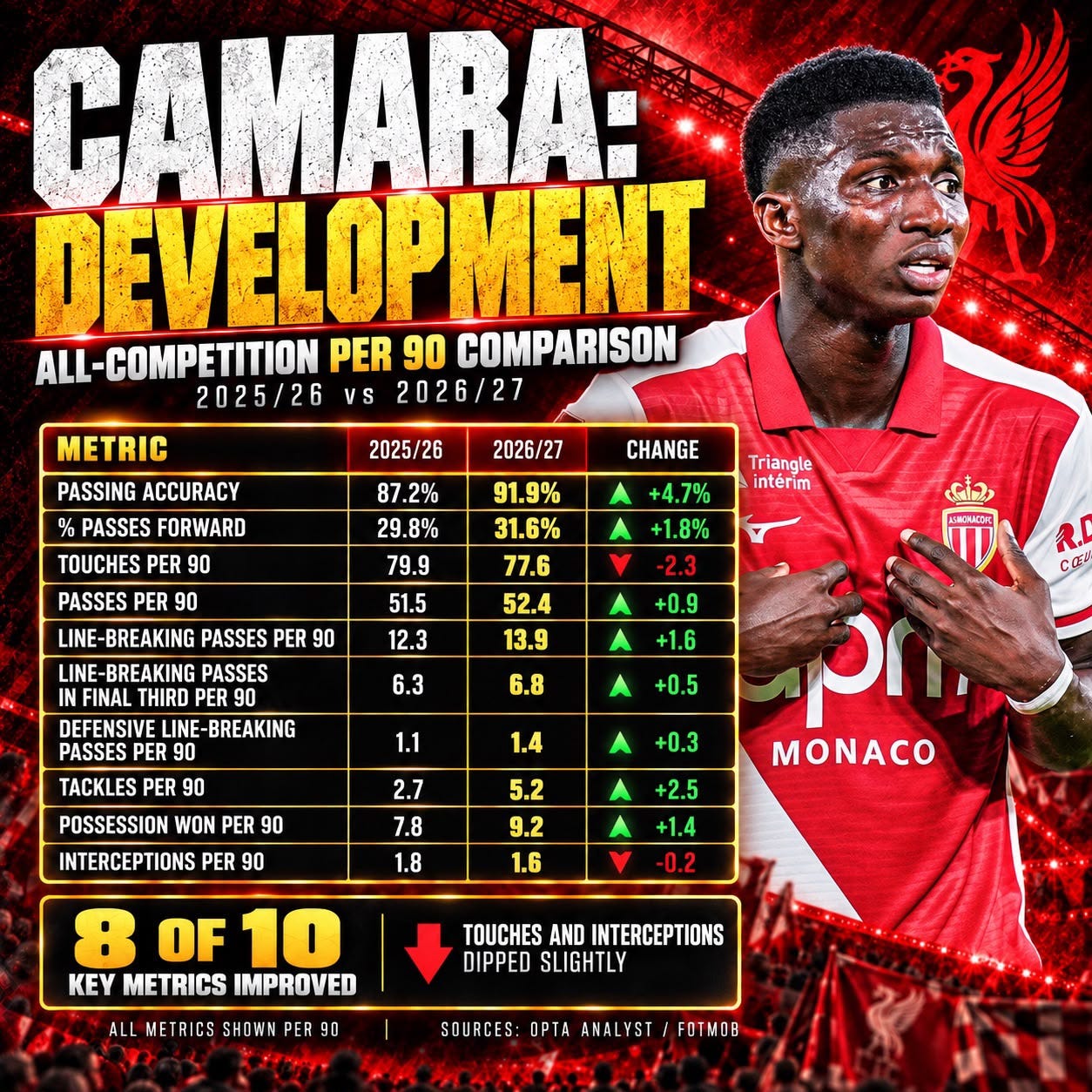
When we compare Camara’s current season with last season, eight of the ten key metrics we assessed have improved.
Passing accuracy has gone from 87.2% to 91.9%. His percentage of passes played forward has increased from 29.8 to 31.6. Passes per 90 have moved from 51.5 to 52.4.
Line breaking passes have risen from 12.3 to 13.9 per 90, while line breaking passes in the final third have increased from 6.3 to 6.8.
Then you get to the defensive work.
Tackles have gone from 2.7 to 5.2 per 90 and possession won has risen from 7.8 to 9.2.
Touches and interceptions have dipped slightly, but the overall trajectory is obvious.
He is 22 years old. That is important because we are watching a midfielder who is still developing rather than someone who has already reached his peak years.
The comparison with Liverpool’s existing midfielders is equally interesting.
Camara recorded 261 successful passes in the sample we used, completing 261 of 281 for 92.9% accuracy. He also completed 26 of 33 long passes, 77.8 per cent, and produced 70 line breaking passes.
Alexis Mac Allister recorded 43 line breaking passes in the comparison and Dominik Szoboszlai 33.
Mac Allister led for progressive passes and passes into the final third, but Camara more than held his own across the possession metrics.

For somebody whose primary responsibility would not necessarily be to provide Liverpool’s creative passing, that is hugely encouraging.
Defensive Numbers Explain Liverpool Appeal
This is where the argument becomes particularly compelling for me.
Liverpool need an actual defensive midfielder.
I have talked about wanting one for years. There is enormous value in having a player who is comfortable sitting in front of the defence and doing the work that allows everybody else to function.
Camara is producing 15.75 duels per 90 in our comparison, winning 65.1% of them. He is making 6.00 tackles per 90, compared with Mac Allister at 3.72 and Szoboszlai at 1.22.
The recovery figure really catches the eye.
Camara is at 9.25 per 90. Mac Allister is at 4.95 and Szoboszlai 4.49.
He also leads the three for interceptions, at 1.50 per 90.
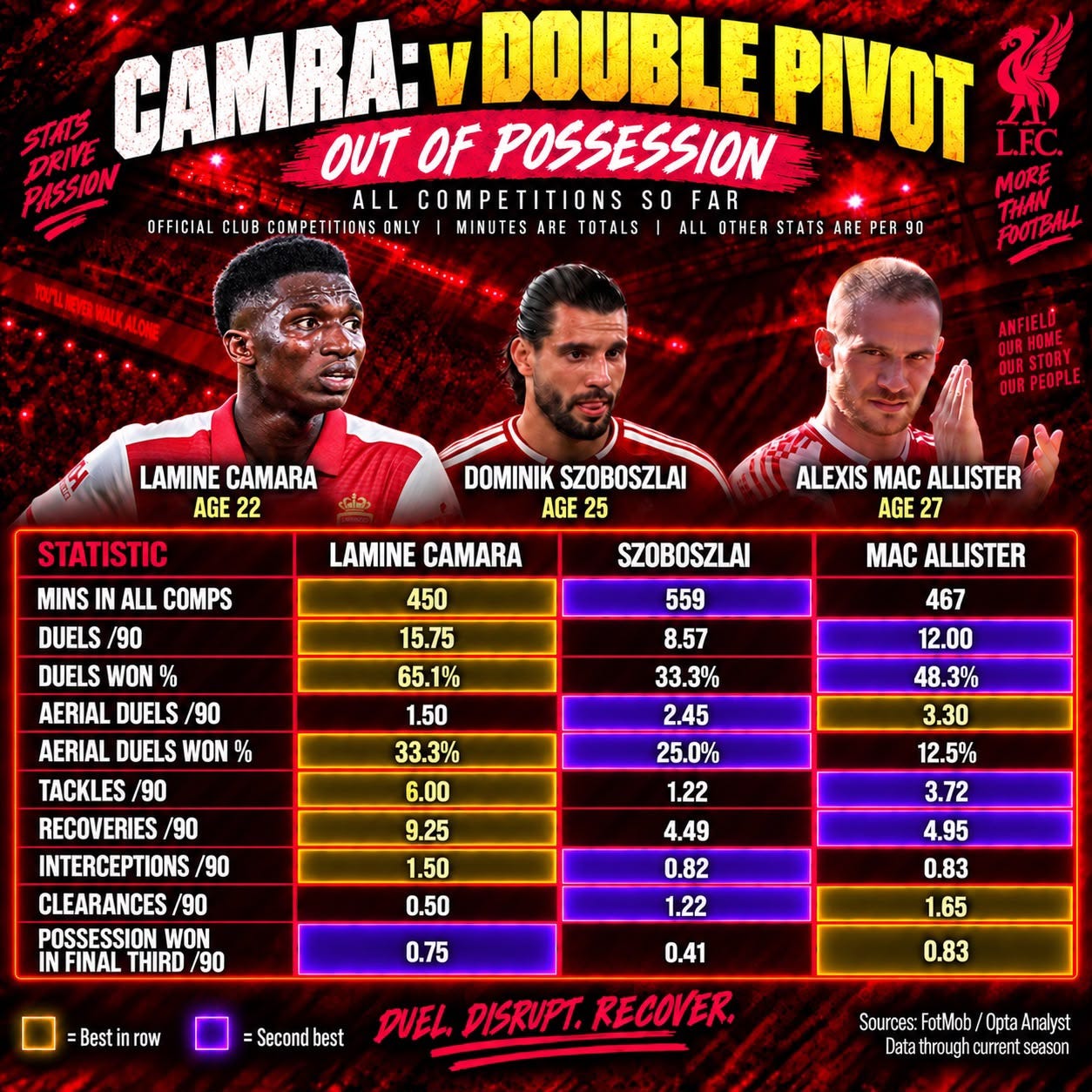
There are always warnings required with individual statistics. Tackles can be misleading without context. Duels are a composite metric and should not be treated as the definitive measure of a player’s defensive ability.
Taken together, however, these numbers tell us something.
Camara provides qualities Liverpool currently need, and his improvement in possession means there does not appear to be the sort of trade off you might have expected previously.
That is why I can now see him playing in Liverpool’s double pivot.
An actual defensive midfielder could also provide the platform for Liverpool’s attacking players to express themselves. We have seen what Florian Wirtz can do when he has proper sixes behind him for Germany. That security matters.
Liverpool’s best midfields have had somebody capable of giving the other players that platform.
Camara looks increasingly capable of doing precisely that.
Scott and Wharton Offer Different Solutions
Alex Scott remains a very good footballer and an interesting Liverpool option.
Iraola knows him. Scott can operate as a six or eight hybrid, covers a huge amount of ground and has produced strong Premier League numbers. In the game we analysed, he ran just under 12 kilometres and reached a top speed around 33km per hour.
He would be a useful addition.
My issue is that I would not want Scott to be the only midfielder Liverpool signed because I do not think he solves the specific defensive problem in the way Camara potentially does.
Adam Wharton presents another fascinating option.
On the ball, Wharton is outstanding. His passing can be genuinely exceptional and his ability to progress possession from deep is obvious. Some of the lazy analysis around him defensively also needs challenging.
He covers around 11.3km per 90, which is not far away from Scott. The difference is in sprinting. Scott produces considerably more sprints, while Wharton tends to remain positionally disciplined in front of the defence.
Wharton still does defensive work. His limitations have sometimes been exaggerated.
Yet Liverpool have changed.
Jeremy Jacquet has provided progression from centre back and Liverpool now have defenders capable of moving the ball through the first line. That potentially changes what is required from the midfield immediately ahead of them.
Liverpool may no longer need to spend the enormous fee it would take to sign Wharton when Camara and Scott potentially provide a better combination for Iraola’s current team.
So my order has changed.
Camara is number one. Scott probably moves ahead of Wharton because of the manager, the structure of the team and what Liverpool currently need.
And with Camara, I would not wait.
I want Liverpool trying to do this in January.
We have improved defensively, but there is still a sense that Liverpool are balancing different requirements because the correct pieces are not yet available in the pivot. Put a genuine defensive midfielder there, someone who can recover possession, tackle, protect transitions and now progress the ball, and you potentially unlock other areas of the team.
That is why Camara feels different.
This could be a player arriving while his trajectory is sharply upwards, with Liverpool getting the benefit of his peak years rather than paying for what he has already achieved.
For me, January is the target.
Get Lamine Camara through the door, put him into that midfield and see what Liverpool can become during the second half of the season.