

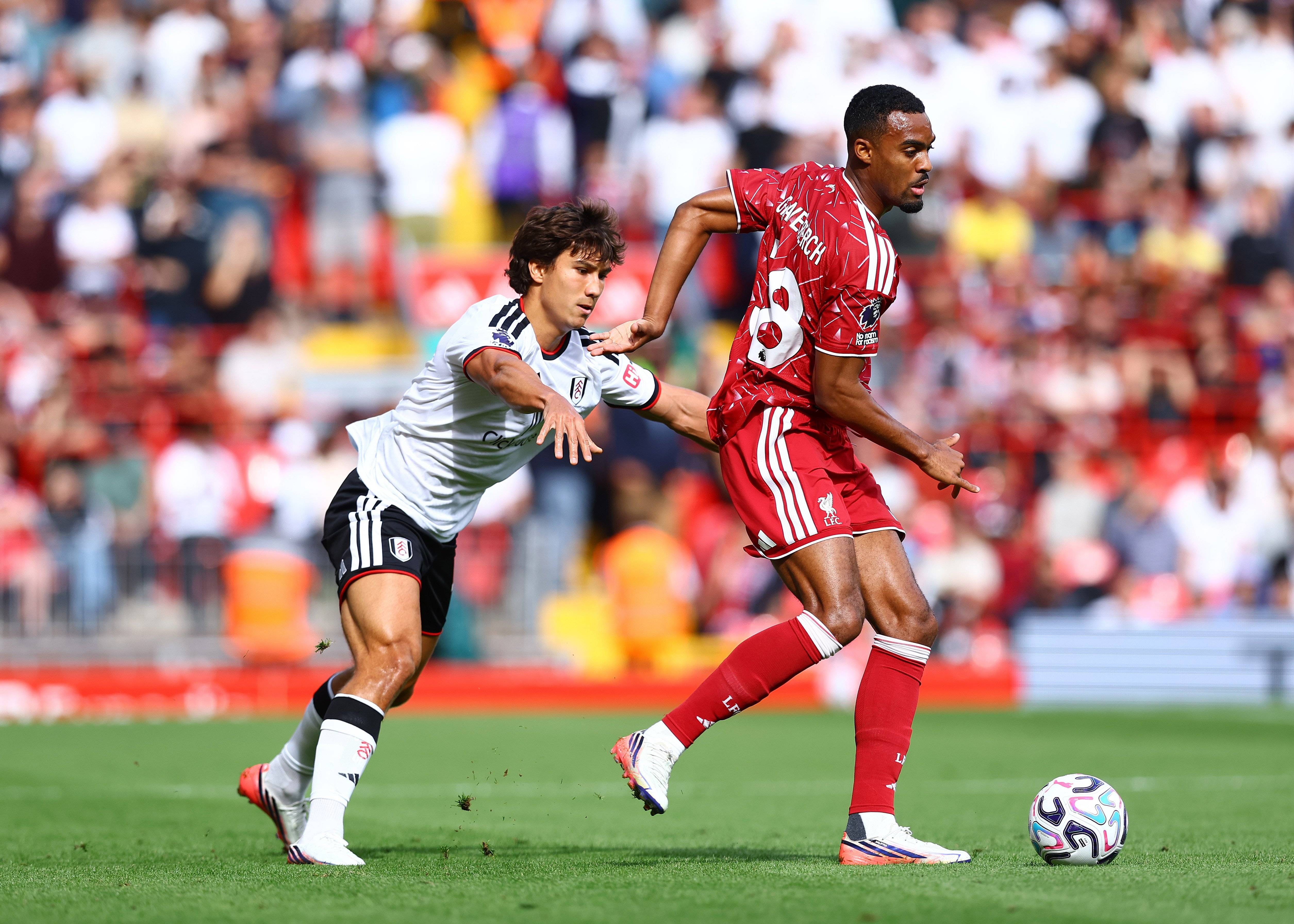
Liverpool kept a clean sheet. That was the consolation. The frustration was everything that happened ahead of the defenders.
Reflecting on the goalless draw with Fulham on Anfield Index’s Full Time Reds, Gags Tandon and Sam Quaye returned to a connected set of problems: tired legs, an unbalanced midfield and attacking players working too hard to compensate for what was happening behind them.
There was criticism, sometimes fierce, but also a distinction between Liverpool’s potential under Andoni Iraola and their ability to deliver his football consistently. This performance exposed the distance between those two things.
Liverpool’s Intensity Came in Short Bursts
Gags placed the afternoon within the demands of the schedule.
“My main reason I think is going to be that it’s the third game of the week,” he said.
His concern was whether Liverpool possessed enough depth to rotate while maintaining the physical demands of Iraola’s approach. Players could produce the required intensity, but sustaining it was another matter.
Sam recognised the same pattern.
“It just seems like they can only do it for, like, five or ten minutes at a time,” he said.
Those bursts brought better pressing, sharper counter-pressing and more convincing build-up. Then Liverpool became passive, allowing Fulham to grow comfortable.
That distinction matters. Liverpool showed glimpses of the football they wanted to play. The problem was their inability to keep playing it.
Wirtz Debate Needs Midfield Context
Florian Wirtz’s performance brought a measured discussion. Neither presenter argued that he had been particularly good, but both questioned whether criticism was properly accounting for his workload.
“The amount of running the man is doing to cover for his midfielders is insane,” Gags said.
That was the central argument: Liverpool’s creative player was repeatedly being drawn towards problems elsewhere.
Sam separated Wirtz’s ability from the environment around him.
“Do we have the structure and the team around him to allow him to do that? No.”
He also demanded greater consistency. An encouraging performance cannot be followed by another afternoon in which influence disappears.
However, Liverpool cannot expect their number ten to provide decisive attacking quality while continually repairing the midfield. Getting Wirtz into better positions requires more reliable work behind him.
Gravenberch and Szoboszlai Raise Questions
Ryan Gravenberch attracted some of the strongest criticism. Gags questioned his passing, tracking and contribution after returning to the starting side.
Sam’s analysis focused on how opponents could limit a midfielder whose outstanding physical qualities were not always supported by sufficiently quick distribution.
“The ball moves quicker than the man,” he said.
Liverpool, in his assessment, needed straightforward progressive passes rather than another carry before releasing possession. Moving the ball earlier could help the team advance before opponents recovered their shape.
The partnership with Dominik Szoboszlai created another concern.
“There’s too much overlap,” Sam said of their strengths.
That diagnosis extended beyond an individual bad afternoon. Two gifted players can still leave a midfield short of complementary qualities, particularly when both are inclined to move towards the action rather than protect the space behind it.
Running Must Serve Liverpool’s Structure
Gags’s disappointment with Szoboszlai came from high expectations. He valued the player’s ability but questioned the defensive effectiveness of his positioning and interventions.
Sam challenged the assumption that visible effort automatically meant useful work.
“You’re actually hurting the team because you’re not keeping the structure,” he said, discussing the danger of pressing alone.
That was one of the discussion’s clearest tactical points. A midfielder charging forward can appear proactive while making life easier for the opposition.
If a simple exchange removes that player from the move, the remaining midfield becomes exposed. Liverpool then depend on recovery running and defensive interventions.
Both presenters discussed alternative roles for Szoboszlai. Their broader point was that Liverpool need clarity about responsibilities before they can achieve balance.
Jacquet Provides a Reason for Optimism
The tone changed when the conversation reached Jérémy Jacquet.
“He was the best player on the pitch for me,” Gags said.
Sam was equally impressed by how comfortable the defender appeared.
“It feels like he’s been there for years.”
That praise offered a contrast to the uncertainty further forward. The presenters saw assurance in Jacquet’s work and encouragement in his developing relationship with Virgil van Dijk.
Ronald Araujo also received praise for his positioning and aerial contribution. Gags valued the security he provided on the right.
The clean sheet therefore had substance within their analysis. Liverpool’s defenders were handling situations that the players ahead of them were not always preventing.
Full-Back Problems Restrict the Attack
Kostas Tsimikas’s display prompted another blunt assessment from Gags.
“He couldn’t get a cross right. He couldn’t get a pass right. He couldn’t get a touch right.”
The concern was how those difficulties affected Liverpool’s attacking connections, particularly the service reaching Bradley Barcola.
Sam broadened the issue to the squad’s options. In his view, Iraola’s system would remain restricted until the full-back and midfield positions offered the required qualities.
Both discussed younger alternatives and the value of genuine competition.
That matters during a demanding schedule. Rotation only helps if the replacement can perform the job. Otherwise, the manager faces a choice between overworking trusted players and accepting a drop in quality.
Isak Offers Initiative, but Bigger Work Remains
Alexander Isak supplied a more encouraging attacking note. Sam felt he grew into the game by seeking involvement rather than waiting for chances.
“In the second half, he took it upon himself,” he said.
That initiative was welcome, but it also reflected Liverpool’s service problem. Attackers were having to find their own route into the contest.
The discussion ultimately pointed towards a collective challenge for Iraola. Liverpool need enough fitness to sustain their pressing, enough discipline to protect the midfield and enough quality in reserve to rotate effectively.
A goalless draw does not erase progress. It does reveal where progress remains fragile.
For Gags and Sam, this was an afternoon when effort, talent and intention failed to become a convincing team performance. Liverpool’s next step is making those qualities work together.