


There are defeats that feel decisive and defeats that feel diagnostic. Liverpool’s 2-1 loss to Manchester City at Anfield sat firmly in the latter category, not because the result was flattering, but because the numbers, the patterns and the tactical rhythms all point towards a side still wrestling with its physical and structural limits.
This was a Premier League match shaped less by moments of brilliance and more by who could sustain intensity, who could manage space, and who could think clearly when fatigue crept in. Manchester City left Anfield with three points, but Liverpool left with evidence, both encouraging and concerning, about where Arne Slot’s side currently stands.
First half control and City’s structural edge
For the opening half hour, Manchester City were the more coherent team. That was not accidental. Their build-up shape, narrow midfield spacing, and targeted overloads down Liverpool’s right side gave them control without chaos.
City completed 465 passes to Liverpool’s 390, with an 85% completion rate compared to Liverpool’s 78%. More telling was where those passes occurred. City played 227 passes in Liverpool’s half to Liverpool’s 151, and completed 61 attacking third passes in the first half alone. Liverpool, by contrast, struggled to move the ball beyond the first line of pressure early on.
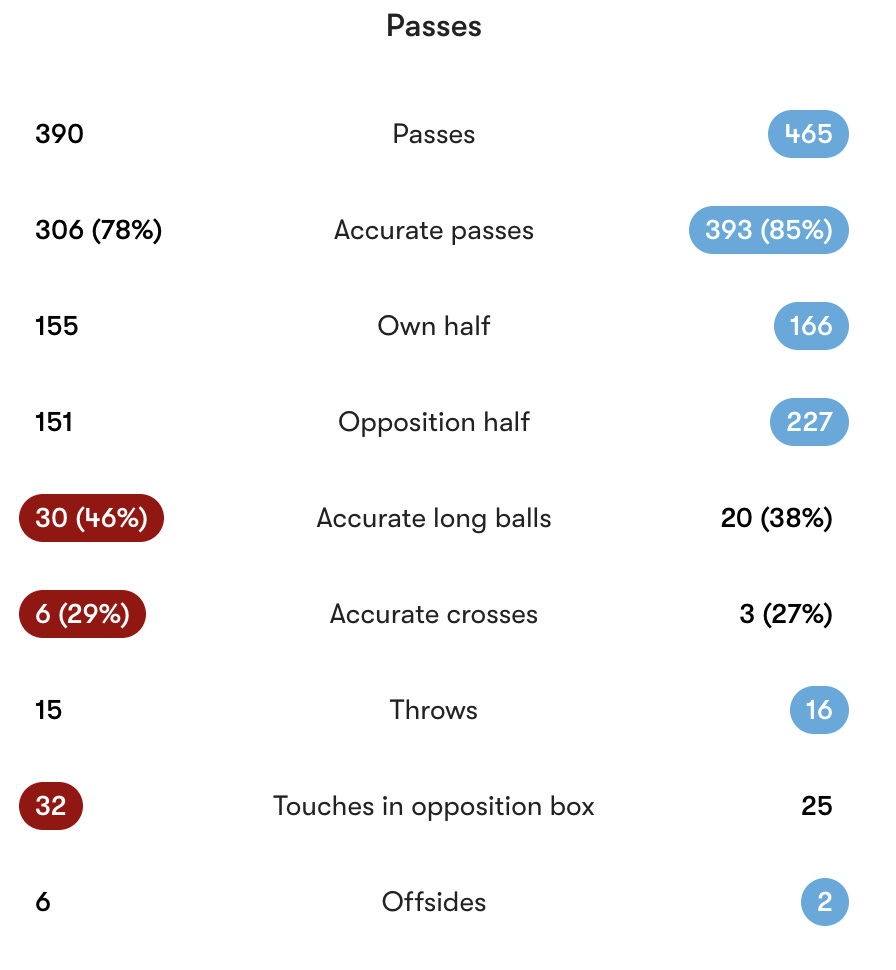
Rodri attempted 49 passes in the first half, Bernardo Silva 32. These were not passive centre back exchanges, they were progressive, controlling touches from the heart of midfield. City’s narrow structure protected Rodri and forced Liverpool wide, while also enabling quick access to runners either side of Erling Haaland.
Liverpool’s press was nominally aggressive, but functionally passive. The distances were right, the shape was recognisable, but the triggers were late. City players received with their heads up, able to scan and select. That distinction mattered.
City’s expected goals at halftime already told the story. They would finish the match with 2.75 xG to Liverpool’s 1.21, and much of that advantage was built before Liverpool truly settled.
