

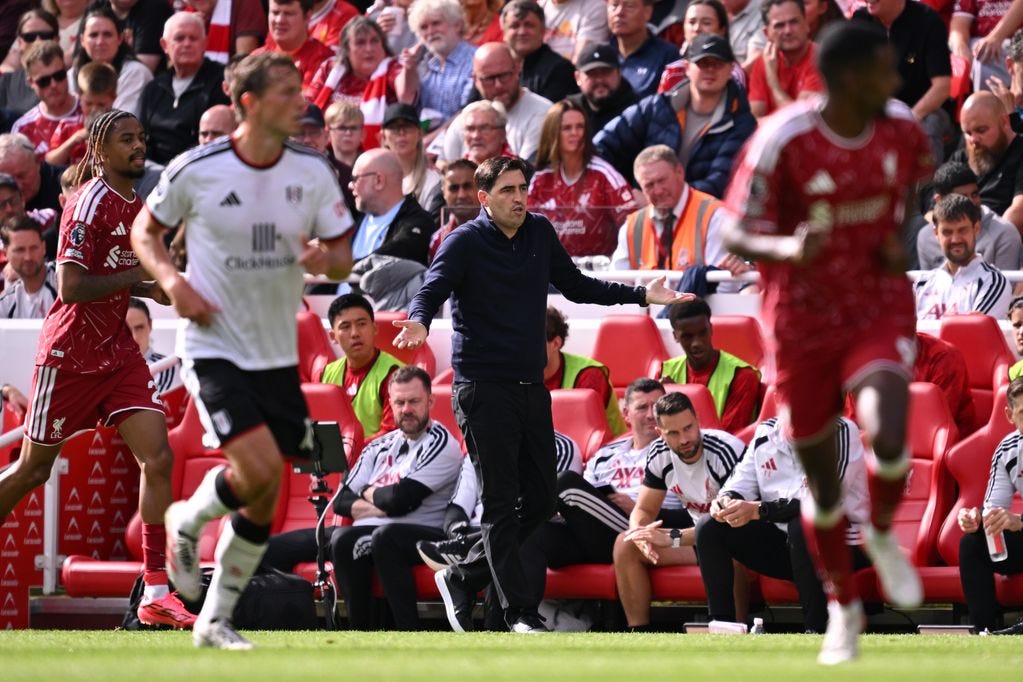
There was frustration after Liverpool’s 0-0 draw with Fulham, and Andoni Iraola shared it. After victories over Ipswich Town and Atletico Madrid, Liverpool wanted a third successive win. Instead, Iraola described the performance as a “step backwards”, admitting his side were “not good enough offensively”.
I actually like that about the new head coach. There is very little waffle. He tells you what he thinks, and after Fulham there was no attempt to disguise the shortcomings.
Looking through the numbers with Michael Reid reinforced some of what I felt watching the game. There are areas that concern me, particularly Liverpool’s ability to get into dangerous positions at Anfield and the balance of the double pivot. There are also significant positives.
Jeremy Jacquet is probably the biggest one.
What matters now is improvement. Liverpool are five games into this process. Iraola is implementing a different style, several new players are learning about each other and a midfield that spent two seasons playing one way is being asked to change again.
That context matters when assessing the numbers.
Fulham Numbers Expose Liverpool’s Biggest Attacking Issue
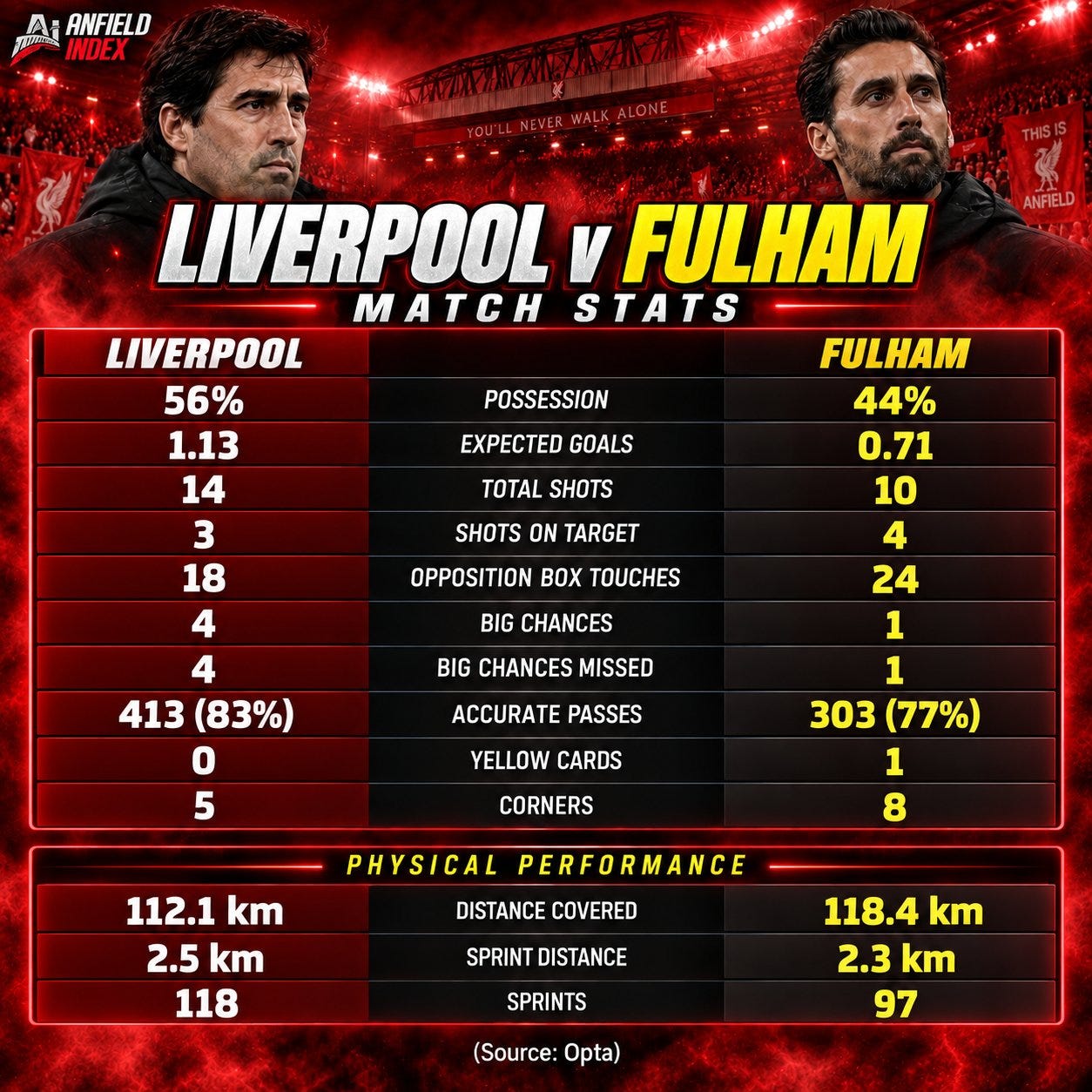
The Fulham game was about as close to the stereotypical 0-0 as you could get. Liverpool had 56% possession, 14 shots and an expected goals figure of 1.13. Fulham managed 10 shots and 0.71 xG.
Liverpool covered 112.1km, while Fulham covered 118.4km. That difference of more than six kilometres caught my attention.
There is context. Liverpool had played Atletico Madrid three days earlier, and Iraola himself referenced the difficulty of playing three games so close together. There is also a possession factor when considering running numbers. Teams controlling the ball should not necessarily be expected to outrun their opponents.
Still, six kilometres is substantial.
Liverpool are moving from the more passive approach we saw during Arne Slot’s final period towards the pressing football Iraola wants. That transformation will take time.
Iraola’s first four Premier League matches have produced six points. Jürgen Klopp took five from his first four. What ultimately defined Klopp’s development was the improvement that followed. That is what I want to see here.
My bigger concern is what is happening at Anfield.
Liverpool had only 18 touches in Fulham’s penalty area. Across the last five seasons, that is the third fewest Liverpool have recorded in a home Premier League game. Against Nottingham Forest this season they managed only 21, which is also among the five lowest totals during that period.
Two of Liverpool’s five lowest totals have therefore arrived in Iraola’s first two home league matches.
Once can be dismissed as a bad afternoon. Twice gets my attention.

Liverpool need to find ways of stretching teams and entering the penalty area more frequently. We have seen glimpses of how it can work. Florian Wirtz has found the winger, the winger has attacked space and Alexander Isak has made the movement inside. We have also seen incisive combinations in the goals against Forest and Ipswich.
We simply need more of them.
Barcola, Isak, Wirtz and Victor Muñoz are learning relationships. That cannot happen instantly. Iraola needs time on the training pitch, but the direction of travel needs to become visible.
If we are still talking about 18 or 21 opposition box touches regularly later in the season, we will be having a very different conversation.
Jeremy Jacquet Looks Like a Liverpool Star in the Making
If there was one Liverpool player who emerged from Saturday with his reputation enhanced, it was Jeremy Jacquet.
He was outstanding.
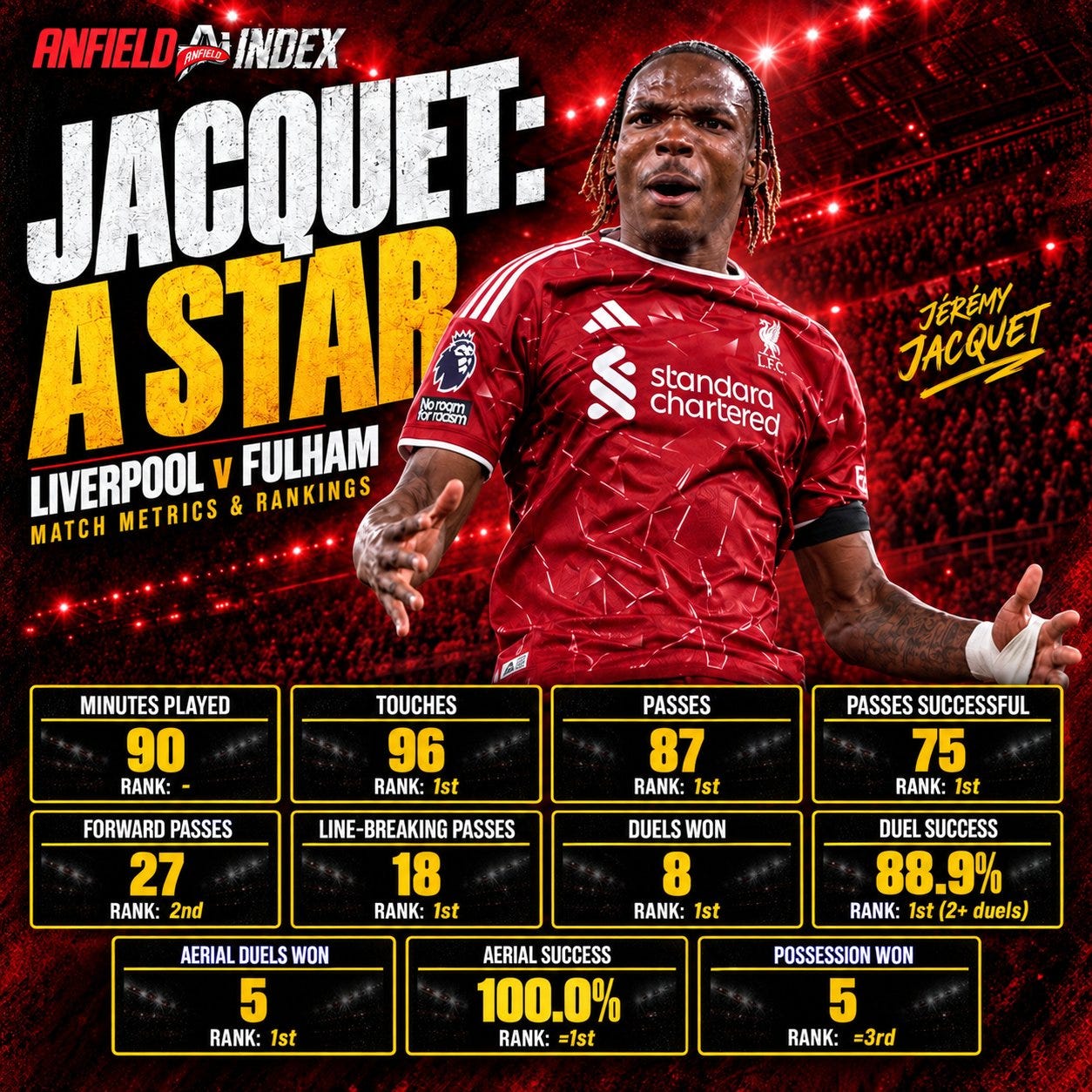
Jacquet played 90 minutes and recorded 96 touches, the most of anyone on the pitch. His 87 passes and 75 successful passes were also game highs. More impressively, 18 were line breaking passes, again the highest figure.
Then look at his defending.
Eight duels won, first in the match. An 88.9% duel success rate, also first among players contesting at least two. Five aerial duels won from five, giving him a 100%t aerial success rate. He also regained possession five times.
At 21, that is some performance.
His importance extends beyond defending. Iraola has previously had centre backs capable of progressing possession, and Liverpool have had that quality for years with Virgil van Dijk. Jacquet showed against Fulham that he can contribute in that area too.
There was also his clearance off the line, which showed excellent defensive awareness.
He will make mistakes. We saw moments against Ipswich where his age was perhaps more apparent. That has to be accepted with a 21 year old centre back. Against Fulham, though, I cannot remember him doing much wrong.
Having Van Dijk alongside him should be hugely beneficial. Ronald Araujo brings considerable experience too.
Jacquet’s emergence also gives Iraola flexibility. Araujo and Joe Gomez can provide options at right back while Conor Bradley is unavailable, while Giovanni Leoni will eventually return to the centre back picture.
There are plenty of questions still to answer, but Jacquet has given Liverpool an unexpected early boost.
Double Pivot Debate Needs More Context
This is probably the area generating the most debate.
Iraola made an important point after Fulham. The problems cannot simply be pinned on the midfielders. He views pressing and ball recovery collectively.
He also said Liverpool were recovering possession too deep. That creates another problem because, once you regain the ball in those areas, you are attacking against 11 opponents. Iraola wants Liverpool recovering possession much higher.
That requires a major adjustment.
Ryan Gravenberch, Alexis Mac Allister and Dominik Szoboszlai spent two seasons being asked to operate differently. They are now learning Iraola’s approach while playing alongside new team-mates and within new structures.

The Bournemouth numbers provide an interesting reference.
Alex Scott averaged 11.66km per game last season and produced 343 sprints. Tyler Adams averaged 11.2km and managed 218 sprints in only 1,778 minutes. Mac Allister averaged 11.4km with 234 sprints, while Gravenberch averaged 10.4km and recorded 230.
Bournemouth also had considerably less possession, which naturally affects those figures.
Still, they illustrate the physical demands associated with Iraola’s football.
Against Fulham, Liverpool’s ground duel numbers in midfield were poor. Gravenberch won two of five, while Szoboszlai won only one of nine. Together, that is three victories from 14 ground duels.
There is no point dressing that up.
Liverpool actually had the superior overall duel success rate, largely because Jacquet and Van Dijk were so strong aerially. In central areas, there was a problem.
Szoboszlai is particularly interesting because his role involves a trade off. He has played every minute so far, including some time at right back, which tells us plenty about how important Iraola considers him.
His attacking contribution also matters. Since the beginning of last season he has 15 goals and 12 assists. Among Liverpool’s midfield options this season he leads for shots per 90 at 2.4 and chances created at 3.2. He also leads for touches, passes, pass accuracy and carry distance in the relevant midfield comparisons.
Mac Allister and Gravenberch appear more prominently across the defensive metrics.
That helps explain the balance Iraola is trying to create.

Verticality Must Become Liverpool’s Next Step
One word kept coming back to me during this discussion, more.
More verticality. More forward passes. More possession recoveries higher up the pitch. More touches in the opposition box.
Iraola repeatedly talks about verticality. Against Fulham there were situations where Liverpool had opportunities to make the more aggressive pass and instead went sideways or backwards.
Again, I think there is an element of relearning involved.
For two seasons these players have often been encouraged to protect possession and control matches. Now they have to assess whether the vertical pass is available and take greater responsibility for playing it.
That carries risk. Lose the ball with an aggressive pass and Liverpool can be exposed in transition. Players therefore have to assess the situation in real time, decide whether the pass is on and understand the positioning behind them if possession is lost.
That level of understanding takes time.
I am encouraged that Iraola appears to recognise exactly where the issues are. I am encouraged by the clean sheets. I am hugely encouraged by Jacquet. I am also intrigued by what Trey Nyoni might eventually add to the midfield discussion, particularly with his passing ability.
There are genuine problems to solve.
Eighteen opposition box touches against Fulham is not enough. Three ground duels won from 14 between the starting pivot is not good enough. Liverpool need to recover possession higher and progress the ball more aggressively when opportunities appear.
None of that means the system cannot work.
Five games represents an extremely small sample. New players are adapting, established players are relearning and Iraola is attempting to introduce a pressing structure that cannot be perfected overnight.
For me, that is how Liverpool’s early numbers should be viewed.
There are warnings in them, especially at Anfield, but there are signs too. Jacquet already looks capable of becoming a major player. Szoboszlai’s physical and attacking output explains why Iraola trusts him. Liverpool have recorded consecutive clean sheets. The attacking combinations have appeared in flashes.
Now I want more of them.
More aggression with the ball, more intensity without it, more entries into dangerous areas and, most importantly, evidence that the numbers are moving in the right direction as Iraola’s Liverpool begins to take shape.