


Liverpool’s defeat to Arsenal on Sunday was frustrating, particularly because there was plenty in the performance to suggest we deserved something from the game. We started poorly, paid for it, and then spent much of the afternoon demonstrating that we can compete with the best side in the country.
On the latest episode of Numbers Don’t Lie, I was joined by Opta analyst Michael Reid to examine what the statistics actually told us.
There were some fascinating findings. Trey Nyoni’s influence was extraordinary for a 19-year-old making his first Premier League start. Ronald Araujo continues to make an overwhelming case for Liverpool to secure his future. And the numbers surrounding refereeing decisions at Anfield raise questions that deserve serious discussion.
We also looked ahead to Fenerbahce, where Liverpool face a difficult assignment against a familiar figure in Dirk Kuyt.
Liverpool vs Arsenal: Trey Nyoni’s Numbers Explain Everything
I’ve said repeatedly that the eye test matters, and watching Liverpool against Arsenal, one thing became increasingly apparent. Nyoni was controlling our midfield.
The statistics make his performance even more impressive.
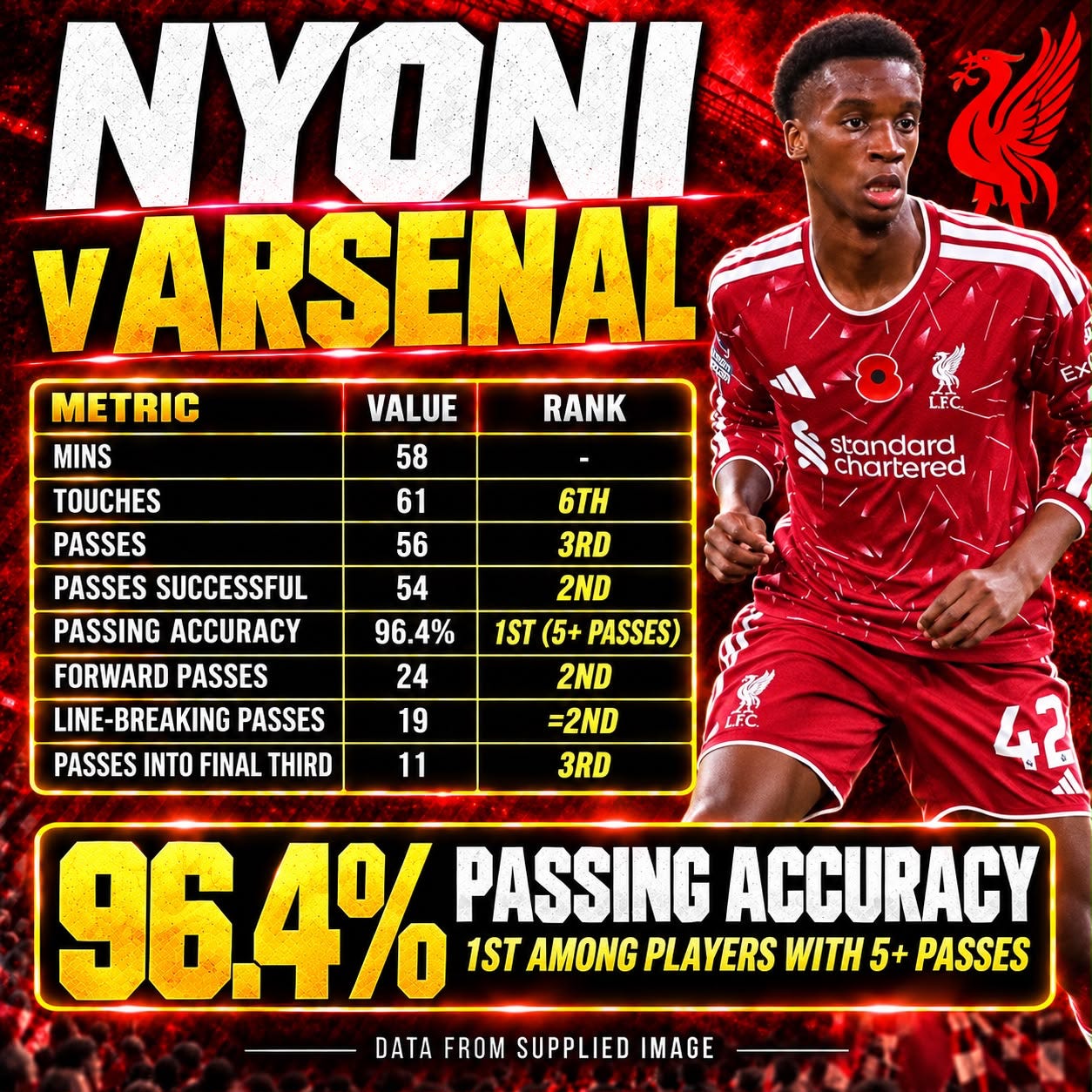
In just 58 minutes, Nyoni recorded 61 touches and completed 54 of his 56 passes, giving him a passing accuracy of 96.4%.
Crucially, those rankings were measured across the entire 90 minutes. Despite playing fewer than two thirds of the match, he ranked second for completed passes, second for forward passes, joint second for line-breaking passes and third for passes into the final third.
That is remarkable against an Arsenal midfield containing Declan Rice, Martin Odegaard and Bruno Guimaraes.
What particularly impressed me was his willingness to demand possession. Here was a teenager dropping between Virgil van Dijk and Jeremy Jacquet, taking responsibility for progressing Liverpool up the pitch.
We cannot expect him to finish the chances his teammates create. His responsibility is to move the ball forward, establish control and help Liverpool reach dangerous positions. He fulfilled that responsibility exceptionally well.
The comparison between Liverpool’s performance before and after his substitution makes compelling reading.
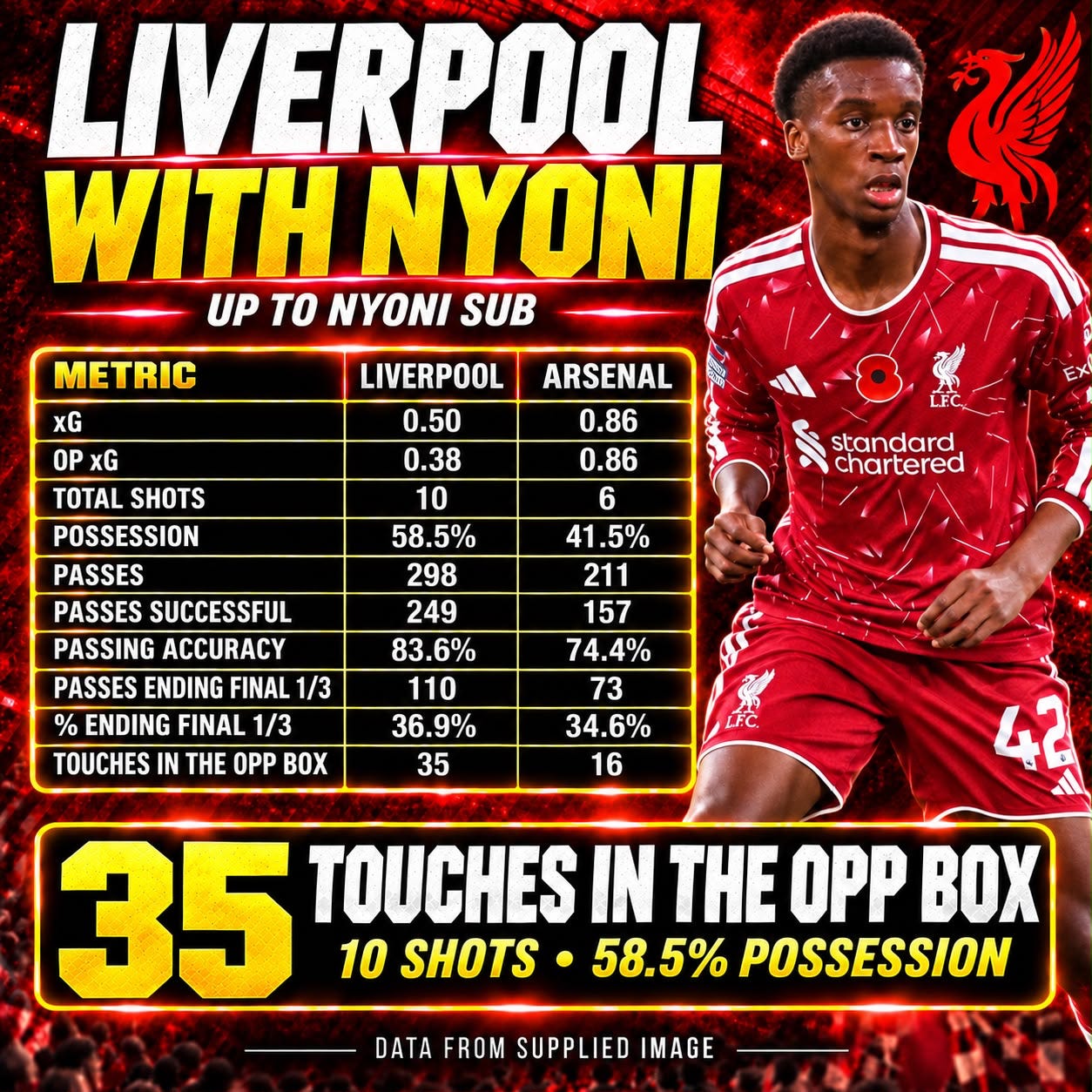
Before Nyoni departed, Liverpool had 58.5% possession, completed 83.6% of their passes and registered 35 touches inside Arsenal’s penalty area. We also produced ten shots and 110 passes ending in the final third.
Those numbers reflected what we were watching. Liverpool were establishing territory and sustaining pressure against a side renowned for its defensive organisation.
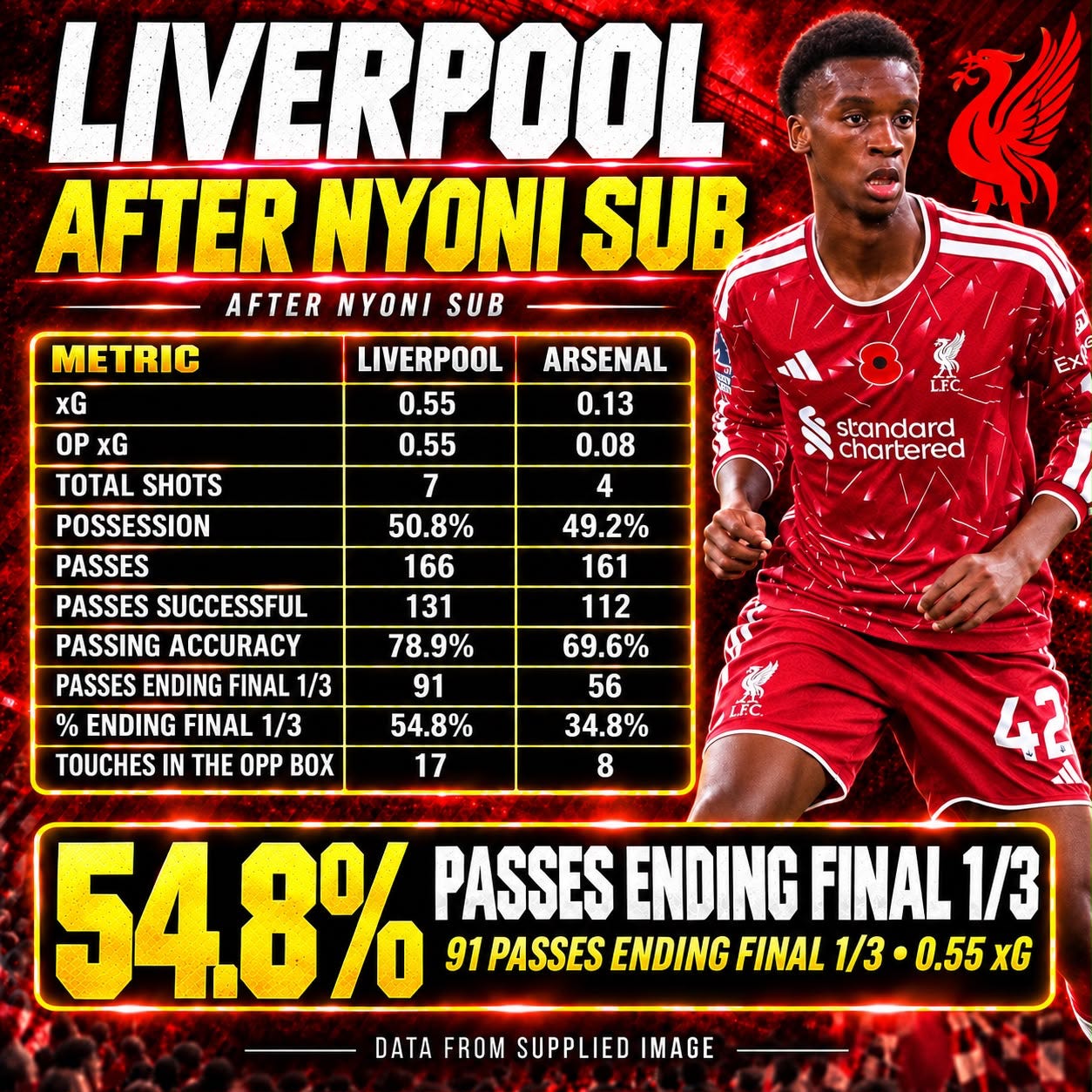
After his withdrawal, possession fell to 50.8%, passing accuracy dropped to 78.9%, and Liverpool managed seven shots.
Interestingly, our expected goals increased slightly, from 0.50 before his substitution to 0.55 afterwards.
That requires context. As I mentioned on the show, Van Dijk was pushed forward late on, with Liverpool looking for knockdowns and opportunities to force an equaliser.
The increased xG did not necessarily reflect greater control or sustained attacking quality.
Arsenal also made changes, which influenced the contest. Nevertheless, the statistical shift was significant.
For me, Nyoni’s performance was arguably the biggest positive from Sunday. It also raises a legitimate question about whether Andoni Iraola should have kept him on the pitch longer.
Ronald Araujo: Why Liverpool Must Complete Barcelona Transfer
There is another player whose importance becomes increasingly obvious every time I watch him.
Ronald Araujo.
I’ve been banging this drum for some time, and the latest numbers reinforce my conviction that Liverpool should make his move permanent.

Araujo has featured in all 14 Liverpool matches this season. His defensive statistics are outstanding.
Across those appearances, he has recorded 39 aerial duels won, 57 total duels won and 58 clearances.
He ranks second among Liverpool players in all three categories.
Who leads them? Virgil van Dijk, naturally.
There is some important context here. Araujo has frequently operated at right-back, where aerial challenges against opposition wingers can differ from those faced by central defenders.
Nevertheless, his contribution remains exceptional.
His positional awareness, physical strength and reading of the game have been evident throughout the campaign. He provides precisely the defensive reliability Liverpool require.
His versatility matters enormously, too. With Conor Bradley and Jeremie Frimpong unavailable, Araujo’s ability to operate at right-back has been invaluable.
He also offers an option at centre-back as Liverpool consider their defensive future beyond Van Dijk.

The reported permanent transfer figure discussed on the show was €55 million.
Michael and I were emphatic about the value of keeping him. There has been talk of Liverpool attempting to negotiate a lower fee, potentially in January, which would obviously benefit the club.
However, at the quoted price, I would have no hesitation.
Araujo is 27, approaching 28, and could provide Liverpool with several more years of high-level defensive performances.
His qualities have also strengthened my belief that Liverpool should retain Van Dijk.
I still regard Virgil as the best defender in world football. His organisation, consistency and influence remain extraordinary.
Keeping that defensive foundation together should be a priority.
Liverpool Refereeing Decisions: Fouls Statistics Raise Serious Questions
We also need to discuss the refereeing.
I have no interest in conspiracy theories, but when the numbers become this pronounced, they deserve examination.
Liverpool have conceded 128 fouls in the Premier League this season, more than any other club.
Meanwhile, we have been awarded only 88 fouls, with just three teams receiving fewer.
That means 58% of the fouls awarded in Liverpool’s league matches have gone against us, the highest proportion of any Premier League side.
Against Arsenal, Liverpool conceded 18 fouls, including 13 in the second half.
We also conceded 18 against Manchester City, when Ryan Gravenberch was sent off.
Add the contentious penalty awarded to Nottingham Forest at Anfield, and there is a collection of incidents that have potentially cost Liverpool valuable points.
The Alexander Isak penalty incident against Arsenal was particularly frustrating.
Iraola’s argument about consistency was persuasive. Cody Gakpo went down dramatically in another incident, which received scrutiny, whereas Isak remained on his feet despite having his shirt pulled while attempting to reach the ball.
I said on the show that players might have to become more streetwise. Sell the contact, make the referee confront the decision.
That is a deeply unsatisfactory position for football to reach.
We should also recognise that Nyoni was fortunate to escape an early booking against Arsenal. Acknowledging that strengthens the case for evaluating these decisions fairly.
Ultimately, Liverpool’s foul statistics warrant attention, particularly given our average possession of approximately 53%.
I want consistency, and I want decisions judged on what actually happens.
Fenerbahce vs Liverpool: Numbers Reveal Difficult Champions League Test
Wednesday’s Champions League trip to Fenerbahce presents a fascinating challenge.
Liverpool supporters understandably associate Istanbul with extraordinary European memories. However, our actual away record against Turkish clubs is considerably less encouraging.
Excluding the neutral venue Champions League final, Liverpool have won only once in eight away matches against Turkish opposition.
That victory came against Trabzonspor under Roy Hodgson.
Dirk Kuyt scored the winner, and remarkably, he remains the last Liverpool player to score away against a Turkish club.
Now Kuyt is preparing to face Liverpool as Fenerbahce’s interim manager.
Football has a remarkable way of producing these connections.
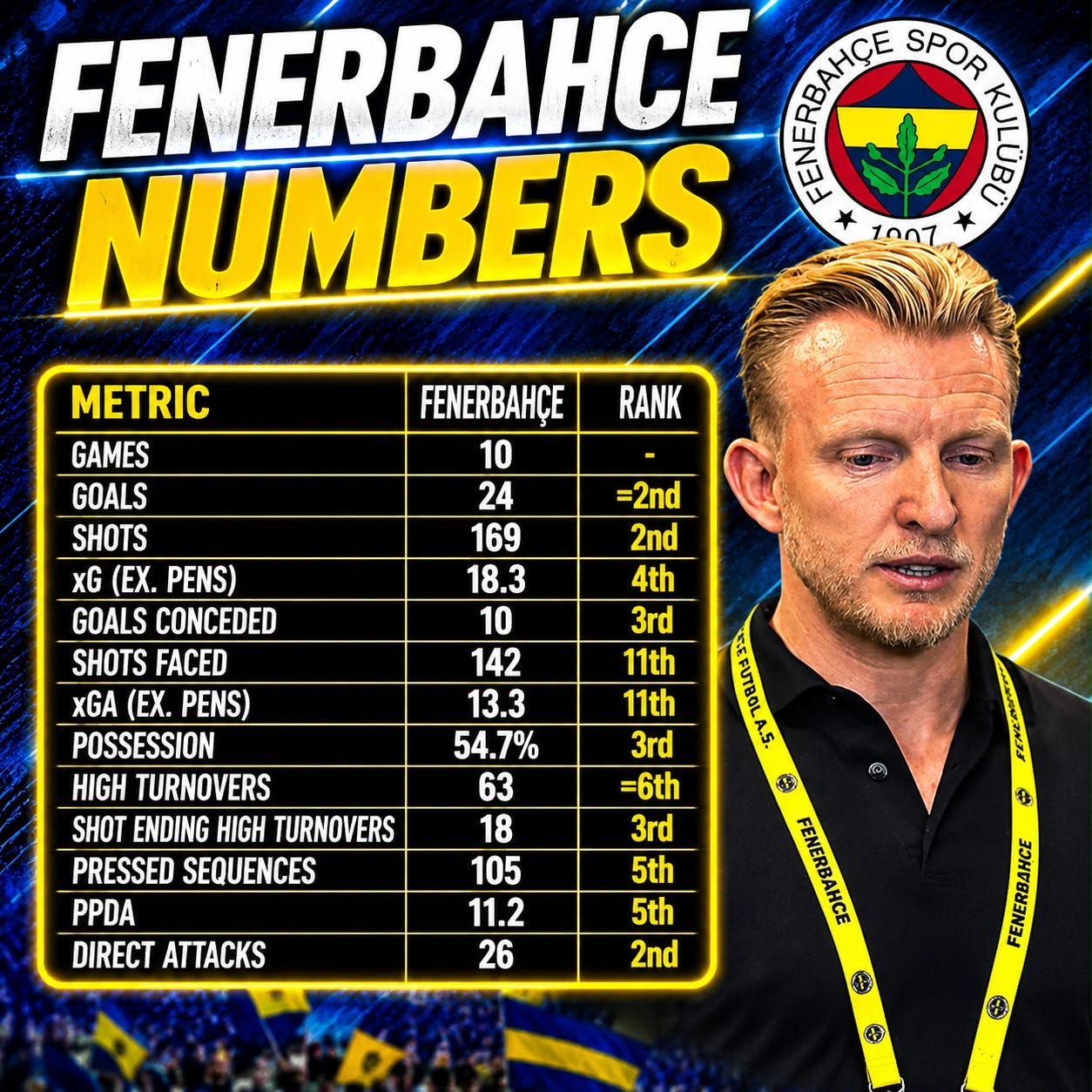
Fenerbahce’s domestic statistics suggest they represent a stronger challenge than their league position might indicate.
Across ten Turkish Super Lig matches, they have scored 24 goals, the joint second-highest total in the division, and attempted 169 shots, ranking second.
Their non-penalty expected goals stand at 18.3, ranking fourth.
Defensively, they have conceded ten goals, ranking third on that measure, although their 142 shots faced and 13.3 non-penalty expected goals against both rank 11th.
Their pressing figures are respectable, with 105 pressed sequences placing them fifth and 18 shot-ending high turnovers ranking third.
Perhaps the most important statistic is their 26 direct attacks, the second-highest figure in the league.
That tells us something about the threat Liverpool must manage.
Fenerbahce are capable of attacking quickly, and we have already seen Newcastle United and Nottingham Forest exploit similar opportunities against us earlier this season.
I believe Liverpool have learned from those experiences, but the warning remains relevant.
The Turkish Super Lig also represents a more demanding standard than the Austrian Bundesliga, making this a tougher assignment than our previous trip to LASK.
We have won our opening three Champions League fixtures, and another victory would be significant.
However, Fenerbahce’s numbers and Liverpool’s historical record in Turkey suggest Wednesday will demand a disciplined performance.
Sunday’s defeat left plenty to debate. Nyoni’s development, Araujo’s importance and Van Dijk’s continuing excellence give me genuine encouragement.
Now Liverpool must translate those positives into results.
And if we can finally end that extraordinary run without an away goal in Turkey, preferably against our old friend Dirk Kuyt, I will certainly take it.