

There is a number I keep coming back to when looking at Liverpool’s opening weeks under Andoni Iraola: 0.5.
That does not refer to expected goals, possession or points per game. It is a reminder about how we should analyse Liverpool at this stage of the season. We have half the picture. We are looking for trends, rather than declaring conclusions.
That distinction matters because some of the early numbers are striking.
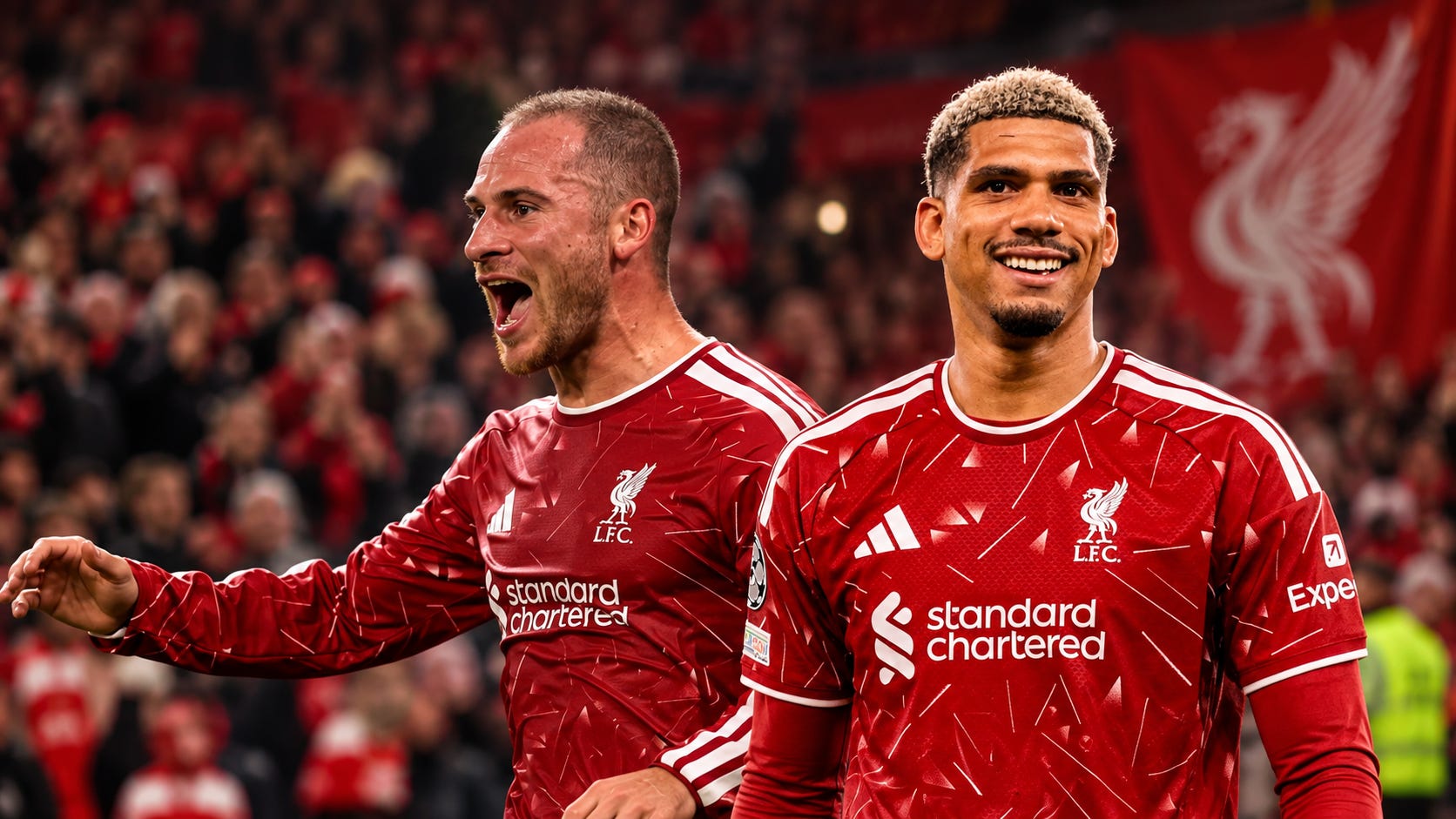
Ronald Araujo replacing Jeremie Frimpong at right back has coincided with a significant reduction in the quality of chances Liverpool are conceding. Alexis Mac Allister replacing Ryan Gravenberch has brought another dimension to the midfield, particularly through tackling, recoveries and line breaking passes.
I have started calling it Liverpool’s South American steel.
There is an important piece of context here. Frimpong and Gravenberch had the benefit of pre season under Iraola. Mac Allister returned later, while Araujo did not arrive on loan until August. Yet it is the latter pair who have quickly become influential.
The temptation is to make this entirely about Araujo. I think that would only tell half the story.
Araujo’s Right Back Impact Is Showing in Liverpool’s xG
Look at Liverpool’s opposition output when Frimpong has started at right back.
Newcastle produced 1.58 xG, Nottingham Forest 2.30 and Tottenham 2.33. That gives you 6.21 opposition xG across those three matches.
With Araujo starting at right back, Ipswich produced 0.75 xG, Fulham 0.71, Bournemouth 0.79 and Atlético Madrid 0.81.
Four games, 3.06 xG conceded. Every opponent below 1.00.
The big chance numbers are equally interesting. Liverpool allowed 12 across Frimpong’s three starts, compared with three across Araujo’s four.
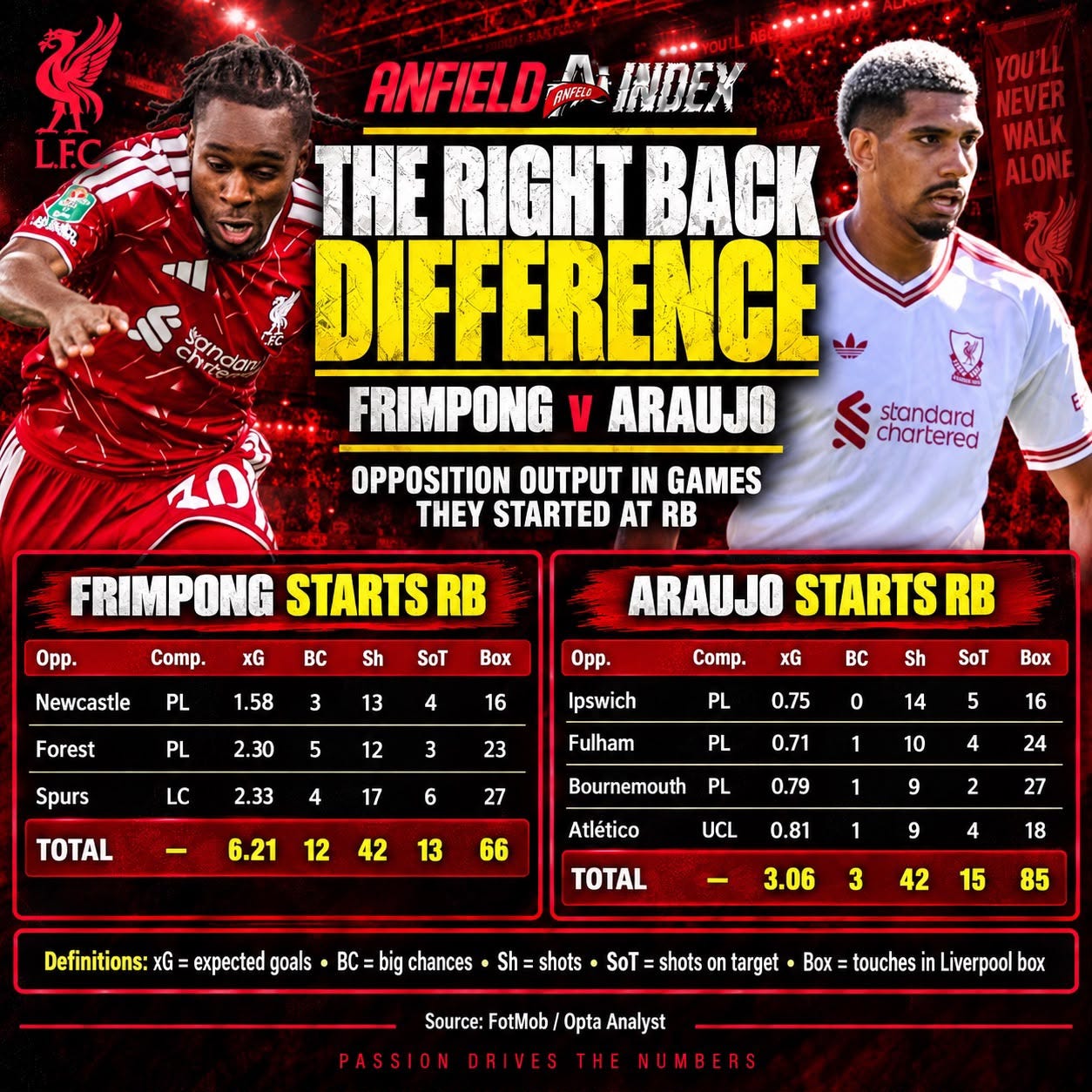
Context is essential. Forest’s figure includes a penalty, which has a major effect on xG. The Tottenham game came with ten Liverpool changes in the Carabao Cup, while Giorgi Mamardashvili missing a corner contributed to one of their clearest opportunities.
Araujo has benefited from Alisson too. Bournemouth produced a dangerous near post opportunity which required an outstanding save.
So I am not presenting 6.21 against 3.06 as definitive proof that one footballer has transformed Liverpool’s defence.
I am saying there is a pattern worth taking seriously.
Araujo’s first Premier League start at right back gave us a clear indication of his qualities. He won all six of his aerial duels, nine of ten ground duels and made seven clearances.
His mentality is defensive. If danger needs clearing, he clears it. He wins physical contests and his aerial success has been above 70 per cent.
Frimpong cannot suddenly become 6ft 3in. His natural instincts are different. He thinks more offensively, while Araujo gives Liverpool another natural defender alongside Jeremy Jacquet and Virgil van Dijk.
I actually thought Frimpong produced possibly his best Liverpool performance against Tottenham. There were signs of him getting tighter and being more aggressive defensively. There are elements he can learn.
The physical difference cannot be coached into him, however.
That matters because Iraola appears to have found a defensive structure which nobody really expected when he arrived.
Mac Allister Completes Liverpool’s Structural Change
Focusing exclusively on Araujo misses what has happened in midfield.
Mac Allister replacing Gravenberch has been every bit as interesting.
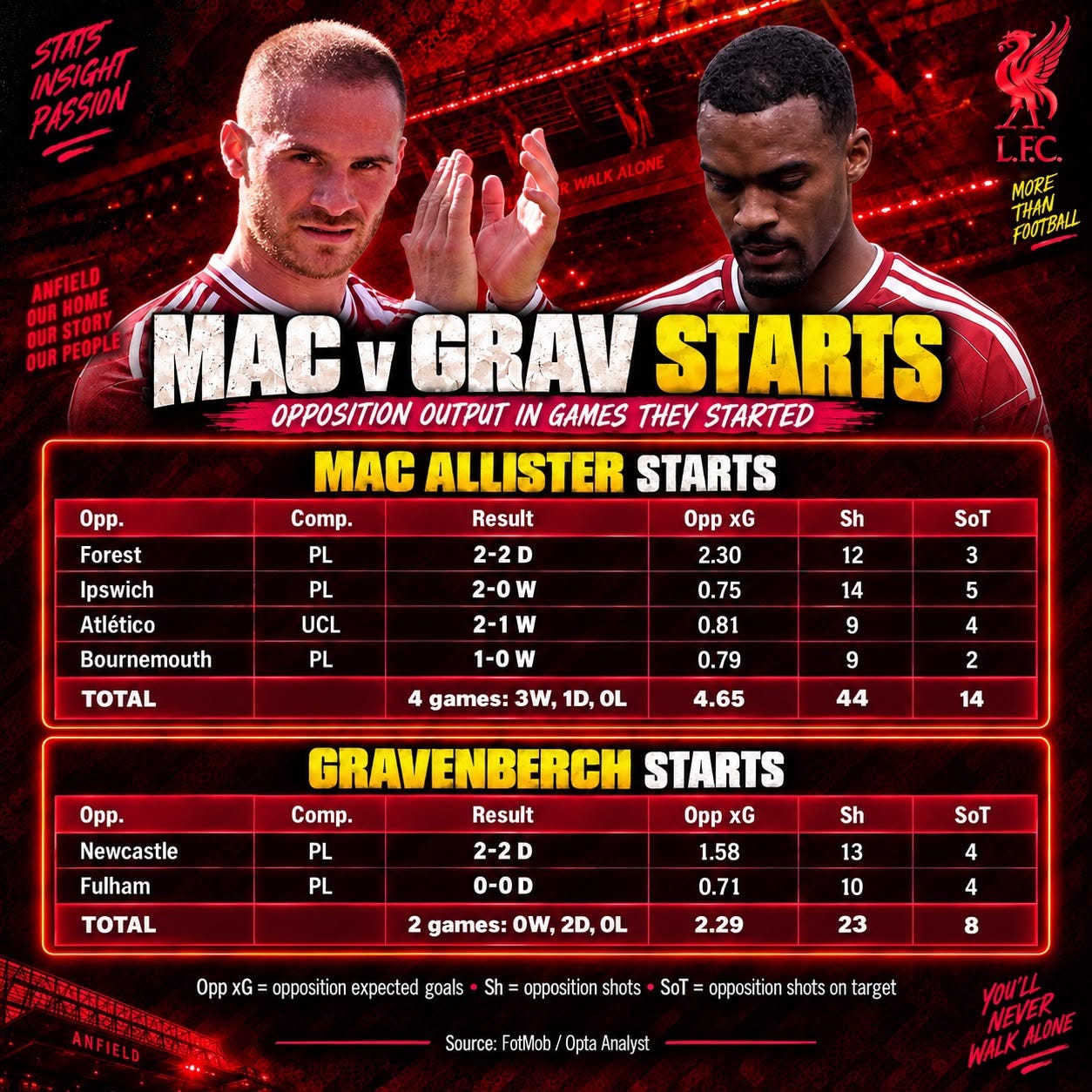
Gravenberch started against Newcastle, when Liverpool conceded 1.58 xG in a 2-2 draw. Mac Allister then started against Forest, Ipswich, Atlético and Bournemouth.
Liverpool have three wins and one draw from those four starts.
Again, we need context. Mac Allister played against Forest with Frimpong at right back and Liverpool conceded 2.30 xG. Gravenberch started against Fulham with Araujo at right back, and while Fulham only produced 0.71 xG, Araujo himself had his poorest statistical performance so far.
That is why I keep returning to combinations.
It does not appear to be as simple as changing Frimpong for Araujo. Liverpool’s early performances suggest there is something about having both Araujo and Mac Allister in this structure.
The individual midfield numbers help explain why.
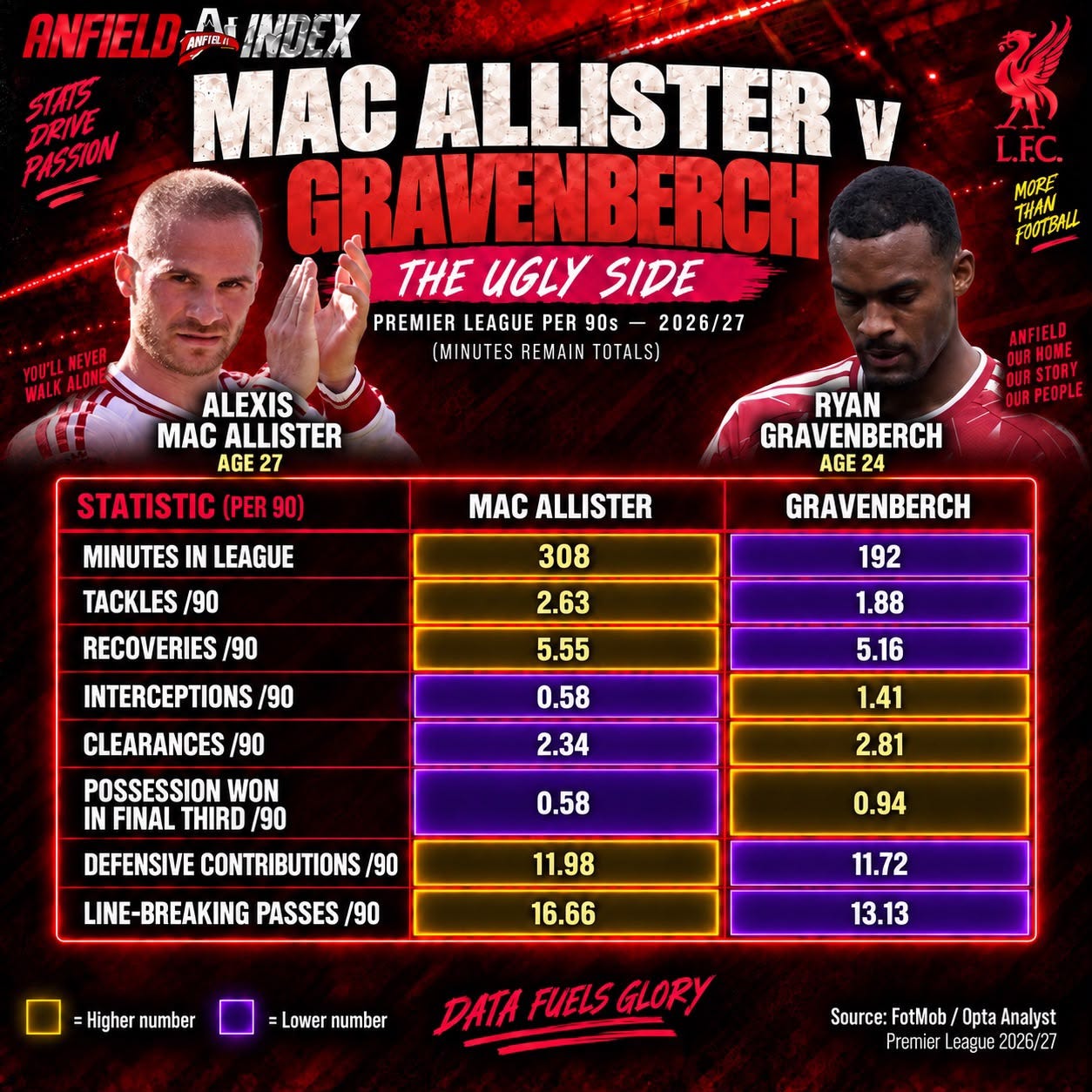
Mac Allister has averaged 2.63 tackles per 90 in the Premier League, compared with Gravenberch’s 1.88. He has 5.55 recoveries per 90 against 5.16.
Gravenberch leads for interceptions, 1.41 to 0.58, and clearances, 2.81 to 2.34. Those are legitimate strengths and should not be ignored.
Then we reach one of the most important numbers of all.
Mac Allister is producing 16.66 line breaking passes per 90, Gravenberch 13.13.
Across the equivalent of a 38 game season, that difference amounts to roughly 134 additional line breaking passes.
That is enormous when you consider what Iraola wants Liverpool to do.
Gravenberch is naturally a carrier. Mac Allister gives Liverpool a player who can receive the ball and immediately punch it through a line. Iraola has repeatedly emphasised verticality and getting the ball forward quickly when opponents are not set.
Liverpool need players capable of executing that idea.
Mac Allister is doing precisely that.
Fulham Showed Why Liverpool Needed More Control
For me, Fulham feels like an important game when assessing Iraola’s early decisions.
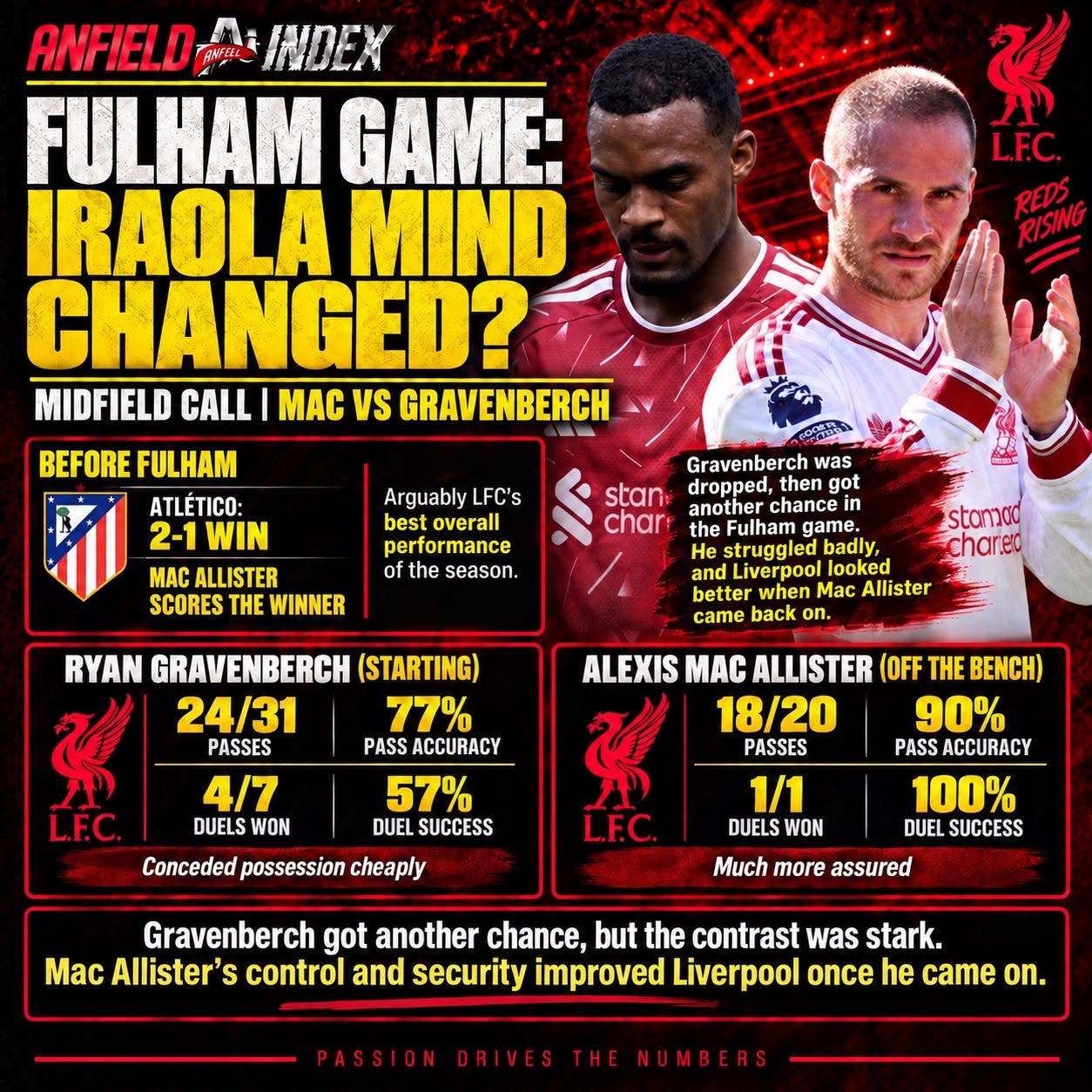
Gravenberch returned to the starting side after Mac Allister had scored the winner against Atlético. His numbers at Fulham were 24 completed passes from 31, giving him 77 per cent accuracy, while he won four of seven duels.
Mac Allister came on and completed 18 of 20 passes, 90 per cent accuracy, and won his only duel.
More importantly, Liverpool immediately looked more assured in possession.
That Bournemouth performance then provided examples of exactly what Mac Allister offers.
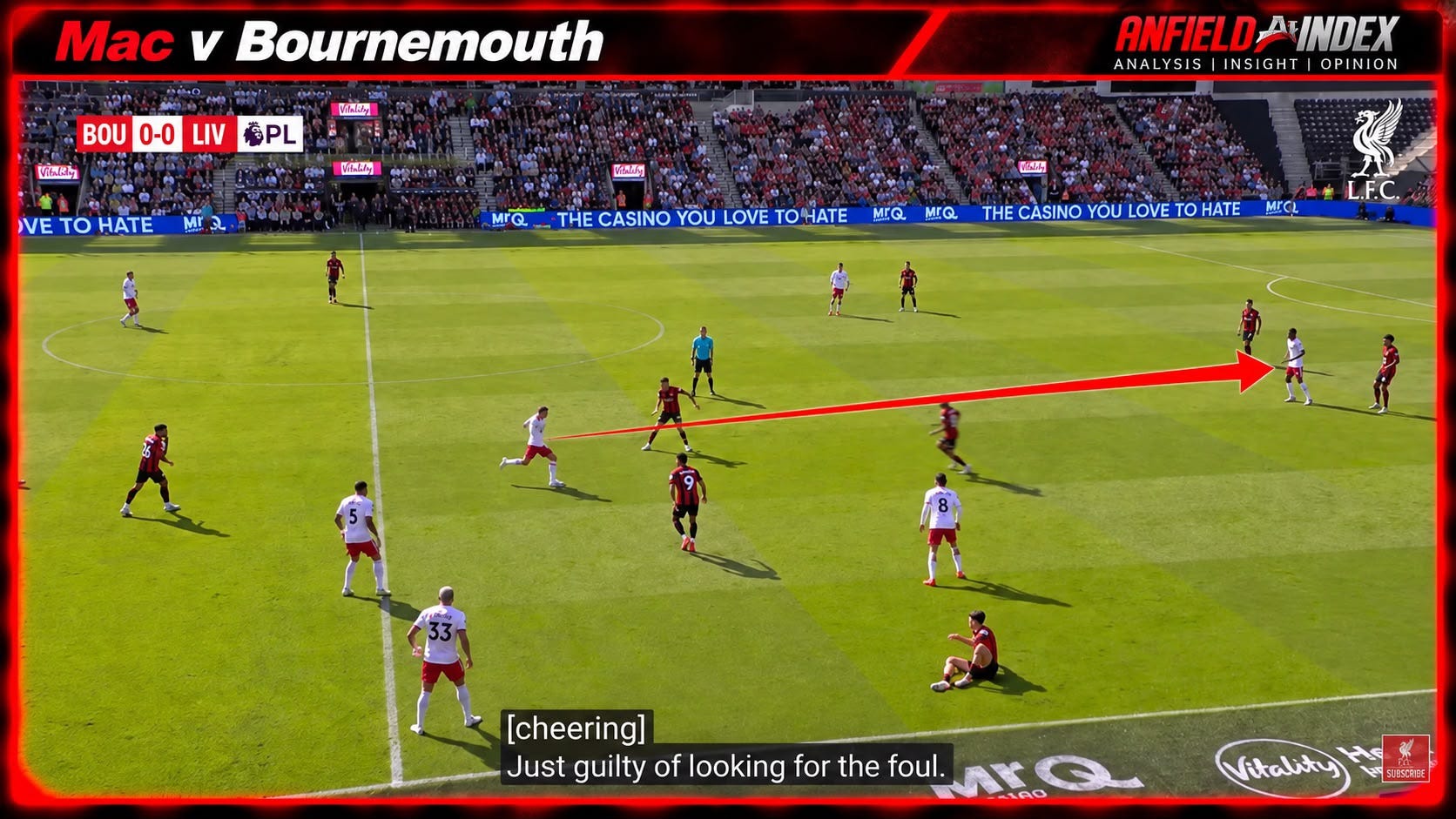
He completed 88 per cent of his passes, made two tackles and seven recoveries. Early in the match, he fired a progressive pass through the line towards Alexander Isak. That move ultimately helped Liverpool win a free kick around the edge of Bournemouth’s area.
Later, with Liverpool protecting a 1-0 advantage and fatigue becoming a factor, Mac Allister recognised the danger as Bournemouth attacked. He recovered into position and intercepted a cutback.
Then he looked forward.
He immediately attempted a long pass towards Victor Muñoz on the right.
That sequence sums up what I mean. There is game intelligence, defensive awareness and the instinct to progress possession quickly.
It fits Iraola’s football.
The manager wants Liverpool to move forward when possession is recovered because that is the moment when an opponent can be disorganised. Mac Allister’s passing profile suits that approach, while Jacquet and Van Dijk can provide similar progression from the defensive line.
South American Steel Is Becoming Iraola’s Early Foundation
There is something else I like about what Iraola has done. There appears to be a genuine meritocracy.
Players have been given opportunities.
Frimpong and Gravenberch had pre season and began the campaign with chances to establish themselves. Iraola then changed things when performances demanded it.
Araujo came in. Mac Allister came in. Cody Gakpo has retained his position through his performances.
That is significant.
We also need to remember the sample size. Seven matches cannot provide definitive answers about a season. Liverpool’s schedule after the international break will present different problems and stronger opposition. The data we have now tells us about emerging tendencies.
Those tendencies are difficult to ignore.
With Araujo at right back, Liverpool’s opposition xG has remained below one in each of his four starts there. His physicality and aerial strength have added another natural defender to the back line.
With Mac Allister in midfield, Liverpool gain tackling, recoveries and, crucially, a greater volume of line breaking passing. His ability to move possession forward fits directly into Iraola’s emphasis on vertical football.
Put those two elements together and Liverpool suddenly have something different.
South American steel.
Araujo provides physicality, duels and defensive security. Mac Allister provides craft, awareness and progression.
The most interesting part is that neither necessarily looked like an obvious cornerstone of Iraola’s Liverpool when pre season began. One arrived late on loan, while the other returned late from his summer commitments.
Yet the early evidence suggests Iraola has found a combination which gives Liverpool a stronger platform.
There will be tougher examinations. There will be games when these numbers move in the opposite direction. There will be tactical situations where different profiles are required.
For now, though, the trend is there.
And at 0.5, trends are exactly what we should be looking for.