


Liverpool’s midfield recruitment is becoming one of the most interesting aspects of our planning for January and beyond. We’ve discussed Lamine Camara extensively, and there are good reasons why I continue to regard him as a particularly attractive option. However, another name deserves serious attention, Sporting CP midfielder Sergi Altimira.
I’ve spent time looking at Altimira’s numbers, examining footage and considering the qualities he could bring to Liverpool. There is plenty to admire, particularly when you look at the specific responsibilities we want from a defensive midfielder.
For me, the starting point is understanding exactly what Liverpool need from their number six.
I’ve used the phrase “prison six” before, and it remains a useful description of the type of midfielder I want us to recruit. Someone who understands his defensive responsibilities, wins possession, protects the important areas of the pitch and gets the team playing again.
Altimira demonstrates many of those qualities.
He’s 25, left-footed, developed through Barcelona’s La Masia system and joined Sporting CP in the summer of 2026. His technical education is immediately apparent when you watch him operate in midfield.
There is a composure about his passing, an understanding of positioning and an ability to recognise when to move the ball forward. Those attributes make him an interesting candidate for Liverpool.
The question is whether those qualities, combined with his physical attributes, would translate successfully into the Premier League.
Sergi Altimira’s Sporting CP Numbers Reveal Significant Progress
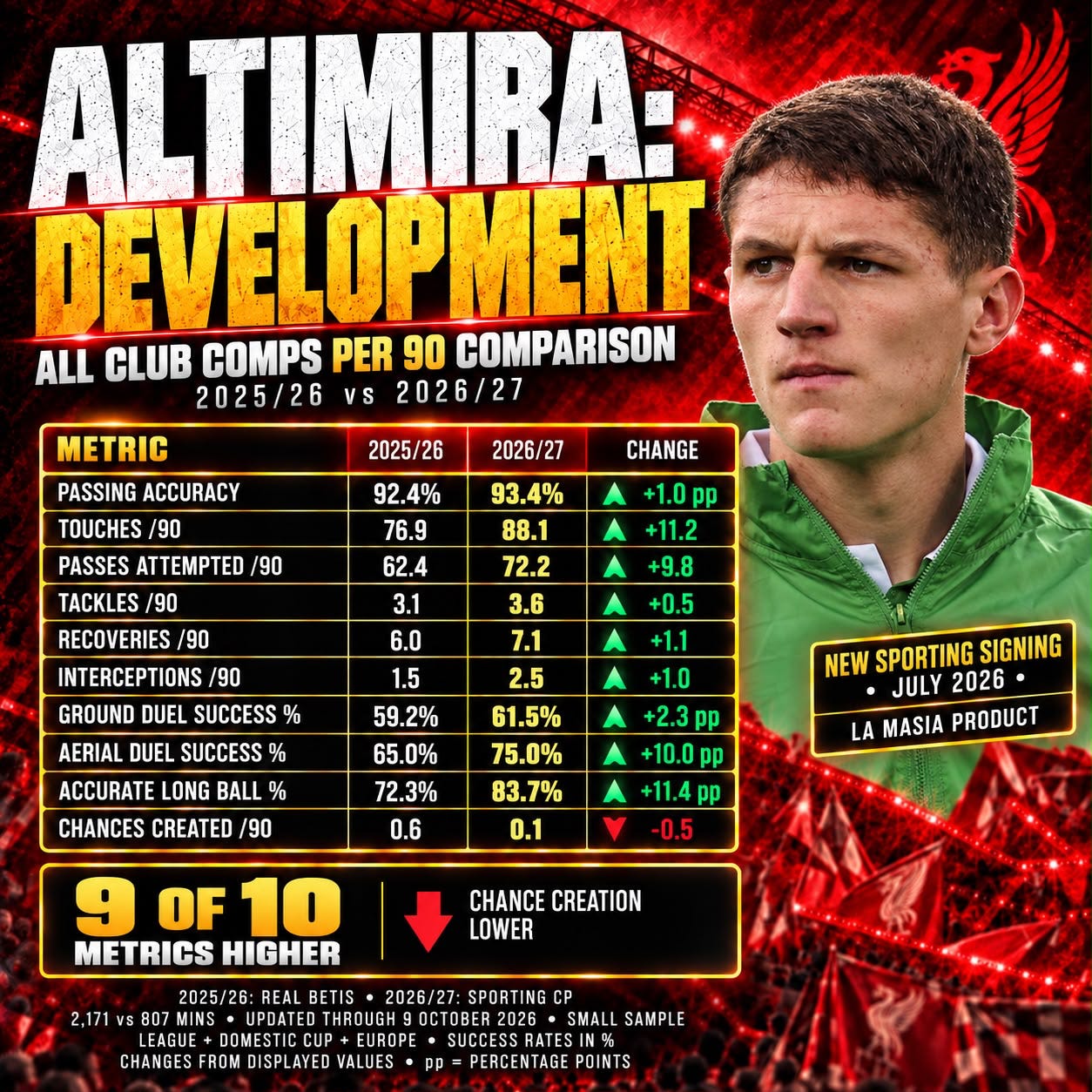
Insert the first graphic showing his 2025/26 Real Betis numbers against his 2026/27 Sporting CP performances, immediately below this heading.
One of the most encouraging aspects of Altimira’s profile is the improvement in his underlying numbers since moving to Sporting CP.
Across the ten metrics we’ve examined, nine have increased compared with his previous season at Real Betis.
His passing accuracy has climbed from 92.4% to 93.4%, while his touches per 90 minutes have increased from 76.9 to 88.1. Passes attempted have also risen substantially, from 62.4 to 72.2 per 90.
Those figures tell us something about his involvement in possession.
Altimira is seeing more of the football, taking greater responsibility for distribution and maintaining excellent passing accuracy despite the increased volume.
For a defensive midfielder, those are encouraging signs.
I want someone who can provide a consistent passing option, recycle possession intelligently and help Liverpool establish control in midfield.
Altimira looks comfortable performing that role.
His defensive numbers have improved too.
Tackles have increased from 3.1 to 3.6 per 90, recoveries from 6.0 to 7.1 and interceptions from 1.5 to 2.5.
That interception figure particularly interests me because it corresponds with what I’ve seen in the footage.
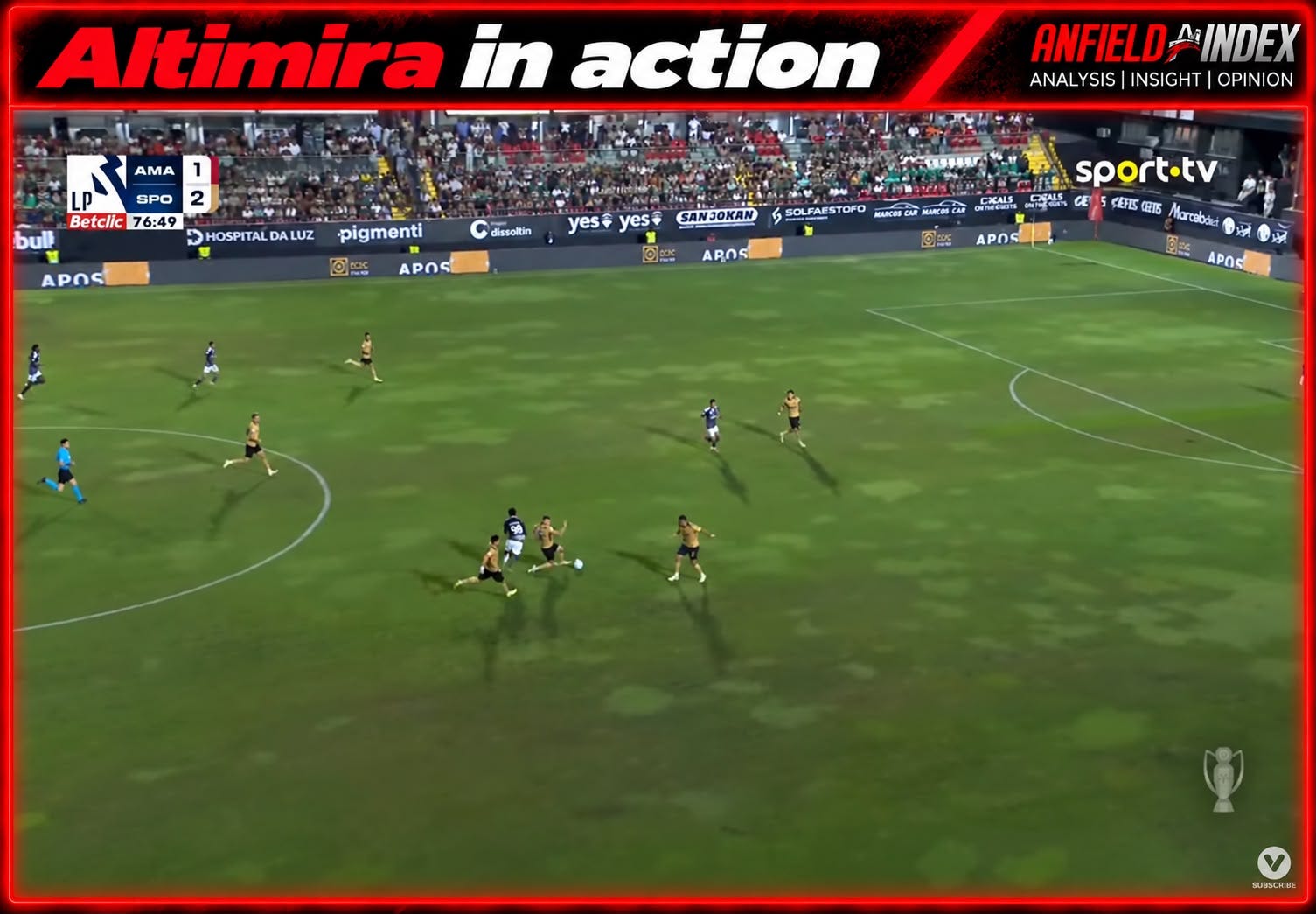
Altimira anticipates situations well. He recognises where opponents are trying to play, moves into the appropriate spaces and has a habit of getting a foot in to disrupt possession.
He likes what I’d describe as a stab tackle, stepping forward to nick the ball before immediately looking for his next action.
There is an intelligence to that defensive work.
He understands his position and generally operates in the areas where you would expect a disciplined number six to be.
The other figure that stands out is his accurate long-ball percentage, which has risen from 72.3% to 83.7%.
That reinforces the impression of a technically accomplished midfielder who can distribute possession over different distances.
There is one declining metric, chances created per 90, which has fallen from 0.6 to 0.1.
I’m relatively unconcerned about that.
We’re assessing a defensive midfielder whose primary responsibilities involve winning possession, maintaining structure and progressing the ball.
Creating chances is a secondary consideration in this particular role.
These comparisons also require context. We’re looking at 807 minutes for Sporting CP against 2,171 minutes for Real Betis, across different competitions and playing environments.
It’s a relatively small sample, and we should acknowledge that before drawing definitive conclusions.
Nevertheless, the direction of his development is encouraging.
Defensive Intelligence and Aerial Dominance Could Help Liverpool
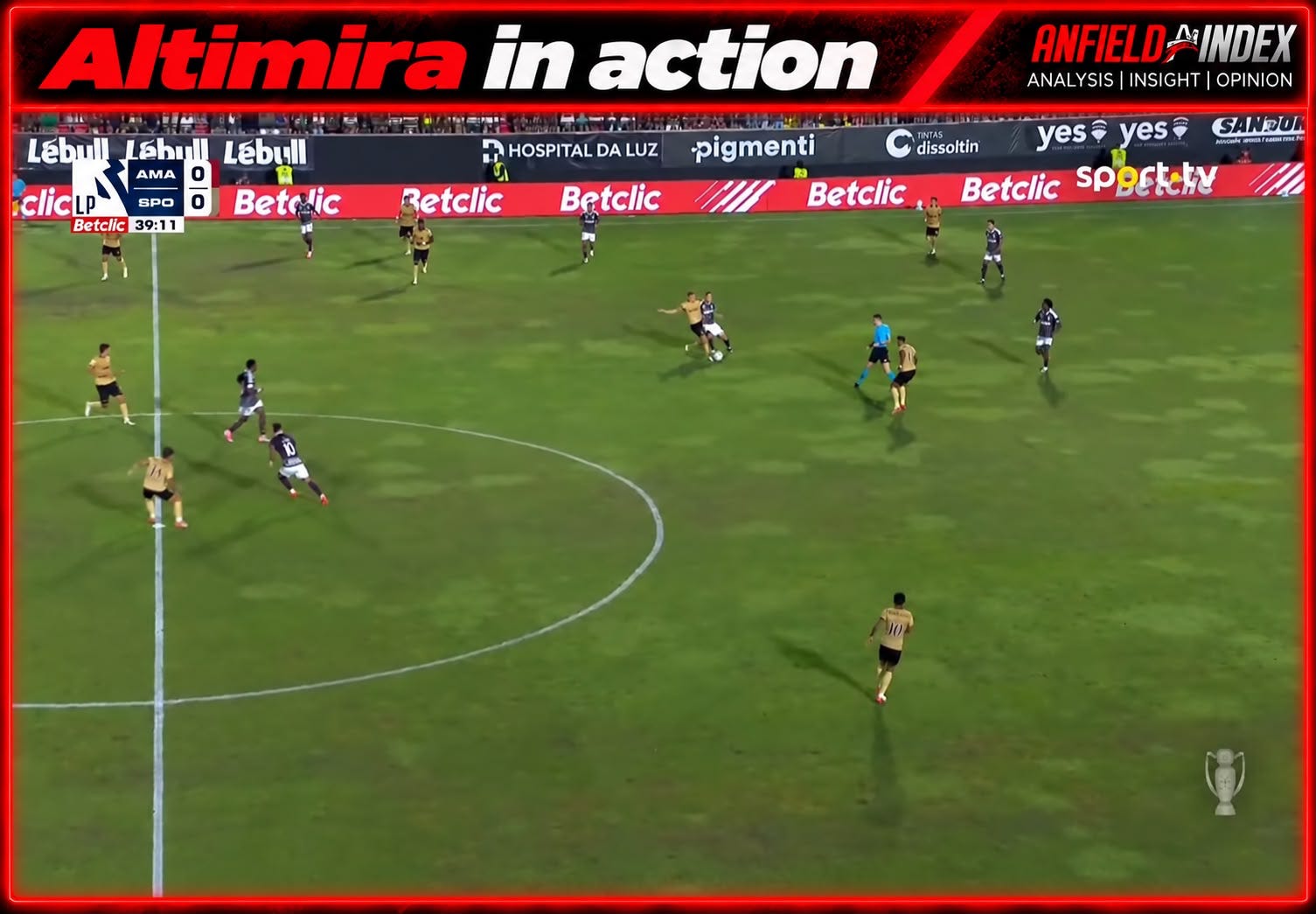
When I watch Altimira, what appeals to me most is the simplicity of his decision-making.
He recognises his job.
He doesn’t appear desperate to abandon his position or occupy attacking areas unnecessarily. He understands where he needs to operate and how to contribute to the team’s defensive structure.
Watch the clips of him recovering possession.
He anticipates the pass, gets across his opponent, makes the challenge and then looks to restart possession.
If there is space ahead, he’s capable of carrying the ball forward. If a simple pass is the better option, he’ll make it.
That discipline is important.
Liverpool need midfielders who can perform their individual responsibilities within a collective system, particularly when we’re discussing a position that provides protection for the defence.
And then we come to the statistic that genuinely made me look twice.
ALTIMIRA, 2026/27
75.0%
Aerial duel success
That is an outstanding figure for a central midfielder.
It has increased from 65% during his previous season, and it represents a significant part of Altimira’s appeal.
We’ve discussed Liverpool’s need for greater physicality in midfield, and winning aerial challenges is an important component of that.
Altimira’s ability in the air could address several problems.
His ground duel success has also increased, from 59.2% to 61.5%, suggesting improvement in another important defensive area.
There are encouraging signs across his defensive profile, particularly when those numbers are considered alongside his positional discipline.
He also covers good distances. We’ve seen him covering approximately 12 kilometres in a Champions League appearance, while maintaining an 89% passing accuracy and completing five passes into the final third.
That gives us another indication of his capacity to contribute across different phases of play.
However, distance covered and outright pace are separate considerations, and that’s where my reservations begin.
Altimira Versus Lamine Camara: Liverpool’s Midfield Recruitment Decision
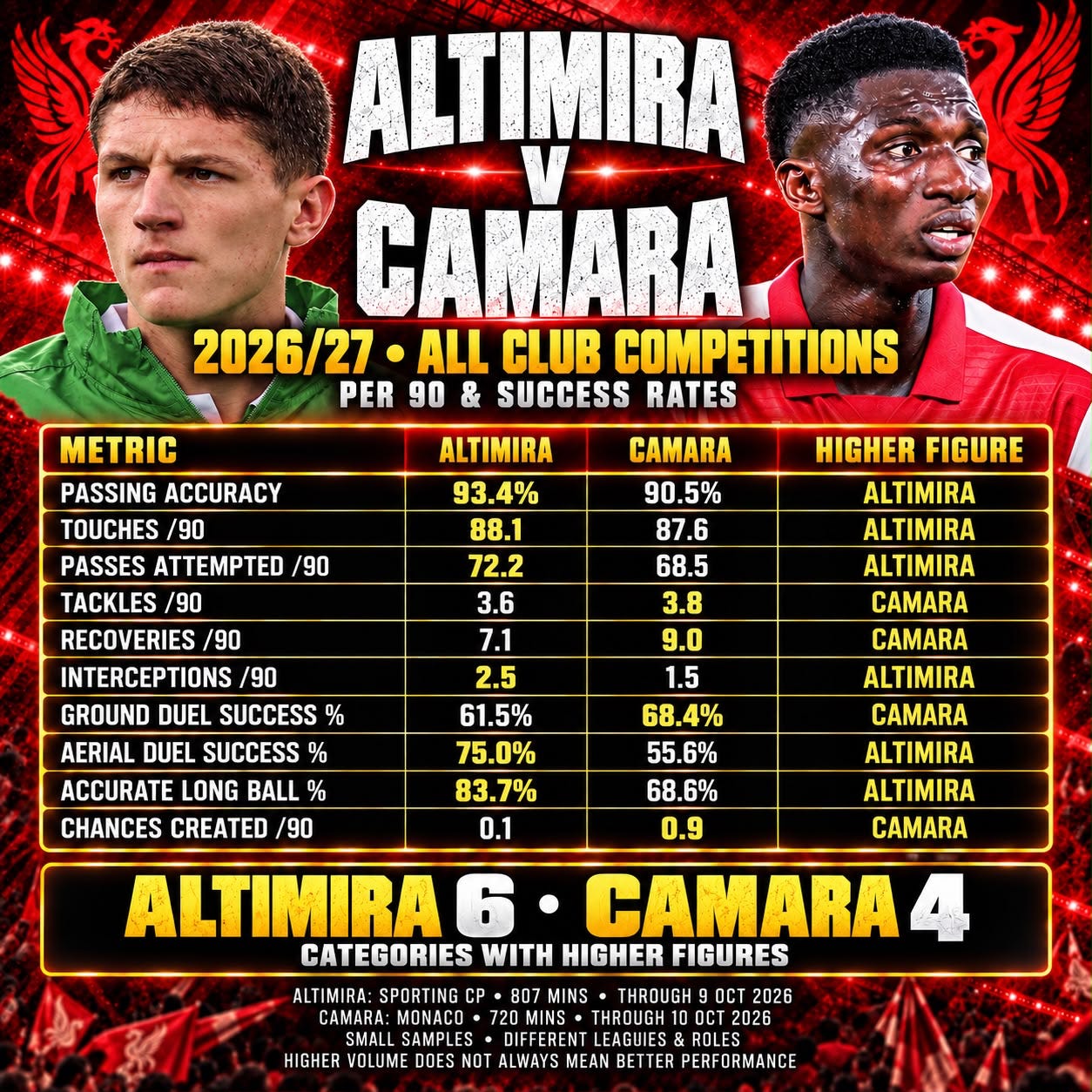
Insert the fifth supplied image, showing the ten-category comparison between Altimira and Lamine Camara.
The comparison with Lamine Camara is particularly relevant because we’ve discussed both players as potential Liverpool midfield recruits.
There are similarities in their defensive responsibilities and their ability to move possession efficiently.
However, their physical profiles differ.
Altimira’s passing accuracy of 93.4% compares favourably with Camara’s 90.5%, while he also attempts slightly more passes per 90, 72.2 against 68.5.
Altimira leads on interceptions, 2.5 to 1.5, and his advantage in aerial duels is substantial.
His 75% aerial success rate compares with Camara’s 55.6%.
His accurate long-ball percentage is also considerably higher, 83.7% against 68.6%.
Those are meaningful differences.
Camara, however, produces more tackles and recoveries, with 3.8 tackles and 9.0 recoveries per 90.
His ground duel success is also higher at 68.4%, compared with Altimira’s 61.5%.
The numbers are competitive across several categories, although their different leagues, responsibilities and relatively small samples complicate direct comparisons.
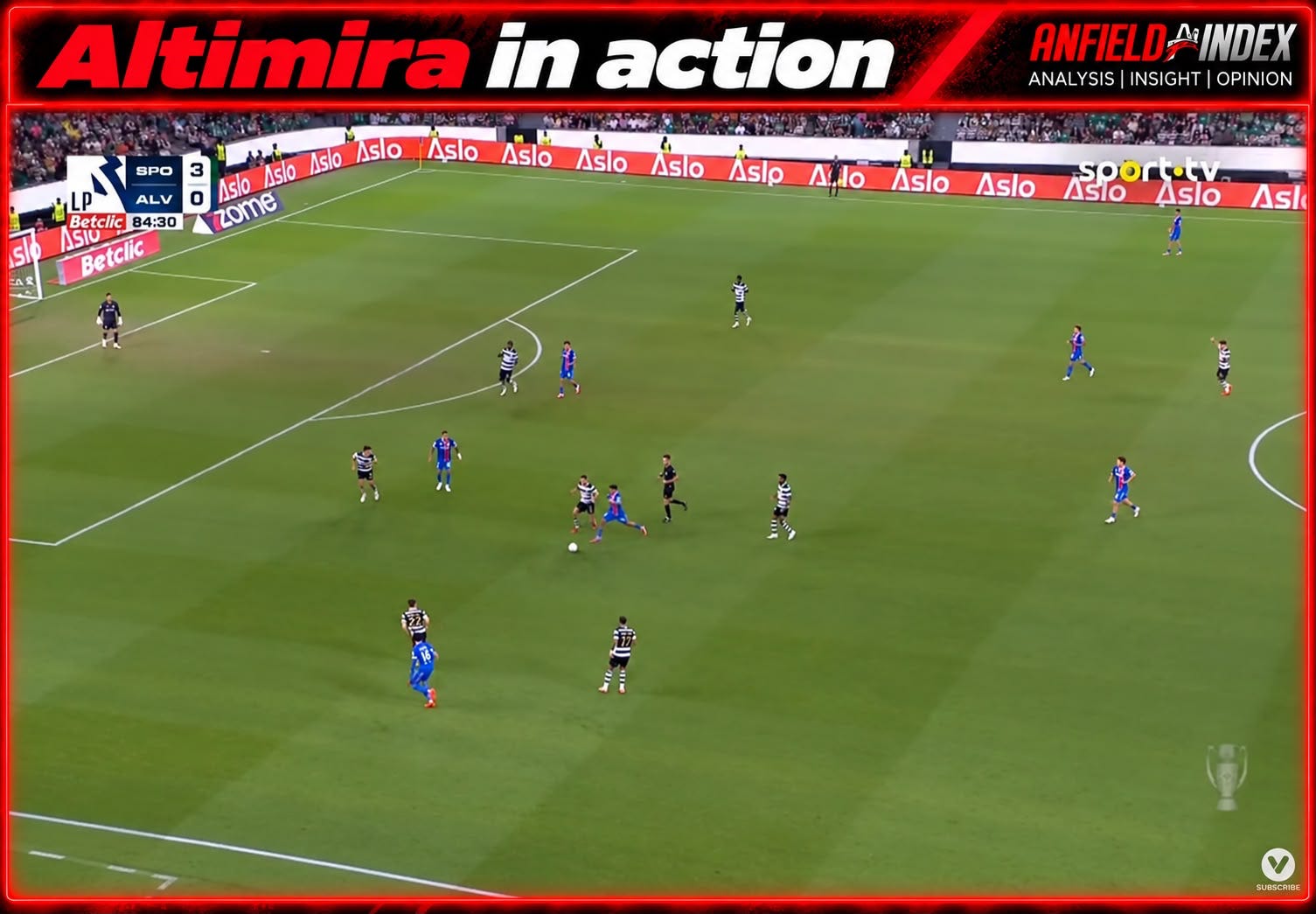
For me, the decisive consideration is mobility.
Altimira has recorded a top speed of approximately 28 kilometres per hour, while Camara operates closer to 30 or 31, potentially reaching 32.
That difference matters when considering the physical demands of the Premier League.
You can have a midfielder who isn’t particularly quick, provided he reads the game intelligently and the players around him complement his attributes.
We’ve seen that principle work before.
However, you need to consider the overall balance of the midfield.
I wouldn’t want Liverpool operating with two players who lack pace in central areas.
Camara’s mobility, defensive contribution and ability to cover ground make me more confident about his capacity to adapt immediately.
That is why, despite Altimira’s excellent technical qualities and aerial superiority, I still lean towards Camara.
Liverpool Must Prioritise Physicality in January Recruitment
Price is another important consideration.
The suggestion is that Sporting CP could entertain an offer somewhere around £30 million to £35 million for Altimira, having signed him for approximately €18 million during the summer.
Camara would likely command a significantly greater fee, potentially £50 million to £60 million in January.
I can understand why Altimira would appeal at the lower valuation.
He’s technically accomplished, positionally disciplined and has produced some very encouraging defensive numbers.
There is certainly a good footballer there.
However, I would be prepared to pay the premium for Camara because I have greater confidence in his physical suitability for the Premier League.
That matters enormously when considering Liverpool’s immediate requirements.
We’re entering an important period of the season, and the danger is that our problems could become more pronounced if results deteriorate.
If Liverpool recruit a defensive midfielder in January, I want someone capable of contributing immediately.
I believe Camara could arrive and perform that role.
With Altimira, I have more uncertainty about the adaptation period.
We’ve seen players require time to adjust physically to English football. Fabinho is an obvious example of someone whose introduction required patience.
There is a possibility Altimira could experience something similar.
He might surprise me. His football intelligence and technical ability are certainly encouraging, and I’d welcome further evidence of how he handles physically demanding opposition.
But based on what I’ve watched, I cannot be as confident about an immediate transition.
That brings us to the wider recruitment philosophy.
Liverpool need to prioritise physical attributes alongside technical quality.
We’ve already got technically capable footballers. The next phase of recruitment must address the physical requirements of the squad in different areas.
Players such as Camara, Altimira and Daniel Banjaqui represent interesting options because they have qualities that can be developed further.
I like the idea of identifying players performing at a good level, bringing them into Liverpool and providing the environment for continued improvement.
That approach has served the club well previously.
With Altimira, there is enough evidence to justify Liverpool’s interest.
His aerial dominance is exceptional, his passing numbers are excellent and his defensive intelligence is obvious in the footage.
At the reported valuation, I can see why he would be considered an attractive option.
Ultimately, though, Camara remains my preferred target because of his mobility and the greater confidence I have in his ability to make an immediate contribution.
Altimira would remain firmly on my shortlist.
He’s a very good footballer, and there is plenty to like about the way he plays the number six role.
The final decision comes down to what Liverpool need most urgently, and how quickly any new signing can provide it.