


Liverpool’s shift under Arne Slot is not primarily tactical. It is architectural. It is a redistribution of stress across the week.
At game 40 under Klopp’s final three seasons, Liverpool had lost on average around 223 player games to injury. Under Slot at the same checkpoint, that number sits close to 101. That is a substantial reduction and it deserves recognition.
But aggregate injury burden does not tell the whole story. The pattern matters. This season we have seen increased reinjury incidence, a concentration of hamstring and rectus femoris injuries, multiple in match withdrawals, and positional clustering, particularly at fullback. Several players have struggled to stabilise match fitness after missing pre season or sustaining early injury.
The shift has not been from injury to no injury. It has been from cumulative overload to exposure instability.
To understand that properly, you have to look at how the week is built.
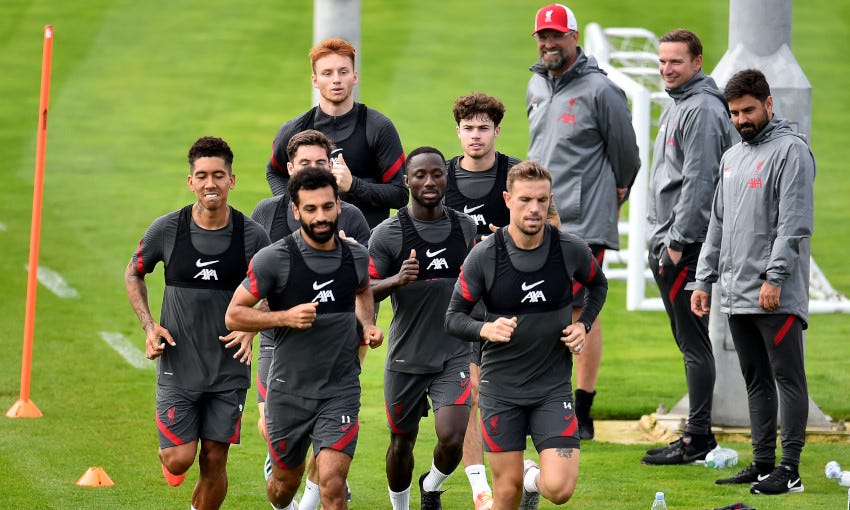
Under Klopp, Liverpool operated within a capacity first ideology. The match was important, but it was not the only high intensity stimulus. Internally it was often described as building toward three times match day demand across the microcycle. That does not mean three literal matches worth of distance, but it does mean that across the week, through structured sessions, high speed exposures, strength work and intense game based drills, the squad accumulated stress beyond what a single match provided.
In simple terms, the tissues were exposed to more than match demand in controlled environments.
When that happens consistently, the match becomes an expression of capacity, not the sole builder of it. The chronic load base sits above match exposure. That carries fatigue risk and cumulative overload risk, and Liverpool paid for that in some seasons. But it also builds tolerance. Sprinting, decelerating, accelerating, absorbing contact, these are not occasional events. They are repeated, rehearsed exposures.
Slot’s architecture appears much closer to one times match demand.
The match is the dominant stimulus. Training between matches emphasises tactical clarity, decision making and freshness. In weeks without midweek games, we have seen multiple instances of three full days off. That is coherent within a tactical periodisation framework. It preserves energy. It sharpens cognition. It reduces cumulative fatigue.
It also changes who adapts.
In a Saturday to Saturday week under a three times match demand culture, even non starters are likely to experience meaningful high speed exposure. There is at least one session where sprint thresholds are touched deliberately. There is usually a strength stimulus layered in. The squad as a whole maintains a relatively stable adaptation curve.
In a one times match demand culture, the starters receive stimulus through repetition of matches. The squad players do not, unless specific top up work is prescribed.
Now compress the calendar.
In a Saturday Wednesday Saturday cycle, the difference becomes sharper.
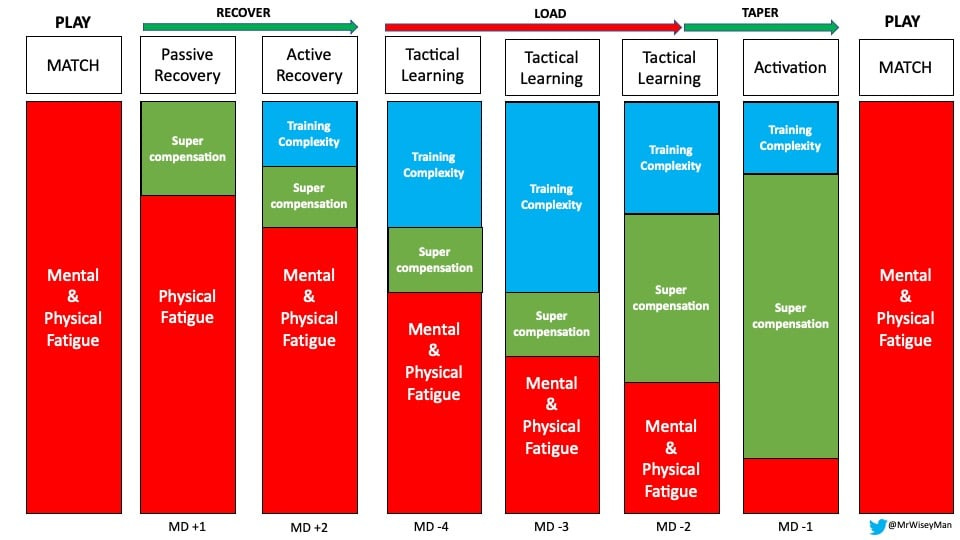
In a three times match demand ideology, the overload is often front loaded earlier in the season. When congestion hits, the chronic base already exists. Training load reduces during the congested week, but the athletes arrive there with a buffer. They have been exposed repeatedly to high speed running beyond match day demands during earlier phases.
In a one times match demand model, the congested week compresses into survival.
Match. Recovery. Tactical rehearsal. Match. Recovery. Activation. Match.
The matches do the work.
For the core thirteen players who start both games, that may be sufficient stimulus.
For the player who plays fifteen minutes, then thirty minutes, then does not play for two weeks, it is not.
Their exposure becomes fragmented. Their chronic sprint base flattens. Then injury or suspension forces them into ninety minutes at elite intensity. That ninety minutes is no longer an expression of capacity. It is the overload event.
This is where the literature becomes relevant.
Ekstrand and Hägglund’s surveillance studies repeatedly show that previous injury is the strongest predictor of future injury. Once a player sustains a hamstring injury, recurrence risk rises sharply. That is the primary multiplier in elite football.
But exposure instability acts as an amplifier.
Recent evidence has shown that reduced competitive exposure in preceding matches is associated with increased hamstring injury risk. Buchheit’s work on near maximal sprint exposure demonstrates that players often enter matches without having achieved near maximal speed in training turnarounds, and that structured high speed exposures appear protective when appropriately programmed.
Hamstrings require consistent exposure to high velocity running to maintain structural tolerance. If sprint exposure is inconsistent, the next maximal sprint becomes the overload.
Jeremy Frimpong provides a case study.

He arrived as an almost ever present player, effectively a guaranteed 3000 to 3500 minute fullback. In game one he strains his semitendinosus. He returns after 22 days. Across the next six weeks he accumulates 356 minutes. He then tears the contralateral hamstring. Eight weeks out. He returns, plays 554 minutes across five weeks, and then tears his rectus femoris on the same side.

This sequence follows established mechanisms. Initial hamstring injury elevates recurrence risk. Contralateral injury is common following unilateral strain due to altered neuromuscular control and compensation. Anterior chain injury following posterior chain pathology is biomechanically plausible.
The structural issue is this.
A previously robust availability profile entered the recurrence cycle almost immediately under the new architecture. Once in that cycle, exposure prescription becomes critical. If high speed overload is not progressively rebuilt in controlled settings, the match becomes the overload event.
At the same time, his positional partner Conor Bradley has been unavailable for the majority of minutes since debut. That is positional clustering. When two players in the same position carry elevated recurrence risk, cascade probability increases. The replacement inherits an unstable exposure profile and is asked to perform at maximal intensity without having built consistent high speed tolerance.
This is not random misfortune. It is exposure maths.
The fullback role illustrates the problem further. Fullback high speed exposure is highly dependent on opponent behaviour and game state. If opponents defend deep, fullbacks may perform frequent accelerations and overlaps but limited maximal retreat sprints. If match play is the main stimulus, and sprint exposure is constrained by tactical context, progressive overload of maximal velocity capacity does not occur.
A fullback cannot rely on the opponent to provide the correct training dose.
Progressive overload requires deliberate prescription.
Without structured high speed exposures above 85 to 90 percent maximal velocity in training, the first time a fullback experiences repeated maximal retreat sprints may be in a chaotic Champions League transition.
That is when hamstrings fail.
Players who miss pre season are even more vulnerable. Whiteley’s research has shown that players returning from hamstring injury often display suppressed high speed outputs despite being cleared to play. If in season return to play relies heavily on match minutes to rebuild fitness, progressive overload occurs in uncontrolled environments. Matches are not rehabilitation tools. They are unpredictable, reactive and unforgiving.
Meanwhile, Liverpool’s pressing intensity has reduced relative to peak Klopp seasons. Global running volume is lower. Transitions often lack early aggression. Reduced pressing may lower cumulative fatigue, but it also reduces repeated acceleration and deceleration exposure. When games open late, players are required to perform high intensity actions without having accumulated consistent submaximal exposures earlier in the week.
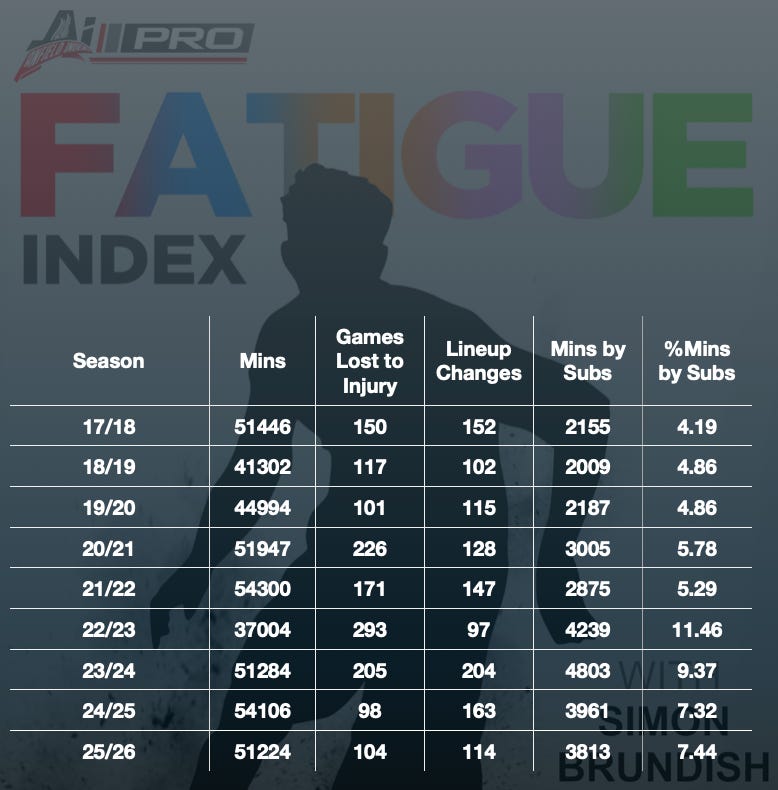
Late match data reflects volatility rather than aerobic collapse. Scoring and conceding heavily in final phases suggests structural openness and exposure gaps rather than conditioning deficiency alone.
The solution is not to abandon freshness.
It is to reconcile freshness with progressive overload.
If a one times match demand philosophy is retained, structured high speed prescription becomes non negotiable. Every outfield player, including non starters, requires weekly near maximal sprint exposure. Squad players require microdosed sprint top ups following matches. Fullbacks require deliberate retreat sprint and deceleration blocks. Return to play must include progressive sprint ladders before full match reintegration.
Without this, the architecture creates two adaptation tiers. Tier one, the starters, adapt through match repetition. Tier two, the squad and returners, adapt through exposure spikes.
Previous injury remains the primary predictor of future injury. Once a player crosses that threshold, exposure management becomes decisive. Frimpong’s transition from durable to recurrent risk illustrates how quickly the risk profile can shift.
Liverpool’s load model under Slot has improved aggregate availability. But soft tissue concentration and positional clustering suggest exposure instability remains unresolved.
The issue is not ideology. It is physiology.
Physiology adapts to what it experiences consistently.
If high speed overload is not experienced consistently, it will eventually arrive in a match.
And the match is the most expensive place for overload to occur.
There is one final layer to this discussion, and it moves us from physiology into performance.
From August until February last season, Liverpool were operating at roughly 2.5 points per game. That is title pace. That is elite output. After February, that number drops to around 1.6 points per game across the subsequent 38 matches.
At some point, something shifted.
You could argue that was simply squad fatigue catching up after years of heavy load under Klopp. You could argue it was tactical evolution from opponents. You could argue it was regression to mean.
But it coincided with a clear philosophical pivot toward freshness.
Liverpool took their first meaningful in-season holiday break in March. After clinching the league against Spurs, the squad spent extended time in Dubai between fixtures. This season alone, the squad has reportedly been sent on holiday four separate times during competitive phases.
The intention is obvious. Reduce cumulative fatigue. Preserve sharpness. Protect availability.
But football performance is not only about freshness. It is about capacity expression.
Under peak Klopp years, Liverpool pressed aggressively and repeatedly. Pressing is not just a tactical instruction, it is a physiological behaviour. It requires repeat accelerations, decelerations, short sprint bursts and high neuromuscular output. It builds tolerance through repetition.
Current Liverpool press less. They often sit in mid-block. Transitions can appear pedestrian. Structural gaps appear when the press is late or fragmented.
This matters because pressing volume is itself a conditioning stimulus.
When pressing intensity drops, repeated acceleration and deceleration exposure drops with it. That may reduce fatigue load, but it also reduces adaptive stimulus.
Now layer in the late game data.
Liverpool have scored 44 percent of their goals in the final 30 minutes. That suggests they still have attacking quality and capacity to produce late.
But they have conceded 51 percent of their goals in the same window.
They have created 38 percent of their expected goals in the final 30 minutes.
They have conceded 52 percent of opponents’ expected goals in that period.
They lose the late game expected goals battle.
That pattern is not classic aerobic collapse. It is volatility. It suggests structural openness, transition exposure and inability to control late phases consistently.
Freshness alone does not guarantee control. Capacity and intensity shape control.
If pressing intensity reduces and high speed exposure is not deliberately overloaded in training, the ability to repeatedly impose tempo late in matches can erode. Games stretch. The team can still score because quality remains. But they also concede because structural pressure is inconsistent.
When you overlay this with the points per game trend, the picture becomes uncomfortable.
From title pace at 2.5 points per game, to 1.6 across 38 matches. That is not variance. That is systemic drift.
It may reflect the gradual fading of the chronic load base built under Klopp. It may reflect tactical conservatism. It may reflect opposition adaptation.
But from a physiological lens, it aligns with a shift from capacity dominance to freshness preservation.
Freshness protects the core group and reduces aggregate games lost.
Capacity wins chaotic games, sustains pressing identity and allows a team to dominate late phases without structural collapse.
Liverpool currently sit in between.
Availability improved, but positional clusters emerged.
Soft tissue shifted from cumulative overload to transitional instability.
Pressing intensity reduced.
Late match volatility increased.
Points per game declined.
This is not an argument to return blindly to three times match demand and grind the squad into the floor.
It is an argument that one times match demand without structured progressive high speed overload creates a two-tier adaptation system and gradually erodes the collective capacity that once defined Liverpool’s identity.
Physiology does not care about ideology.
It adapts to consistent exposure.
If the exposure shifts, the identity eventually shifts with it.
And the data suggests that is exactly what has happened.
Top work Simon, can’t remember the last time I’ve enjoyed an S&C read as much as this.
Great read, Si.